

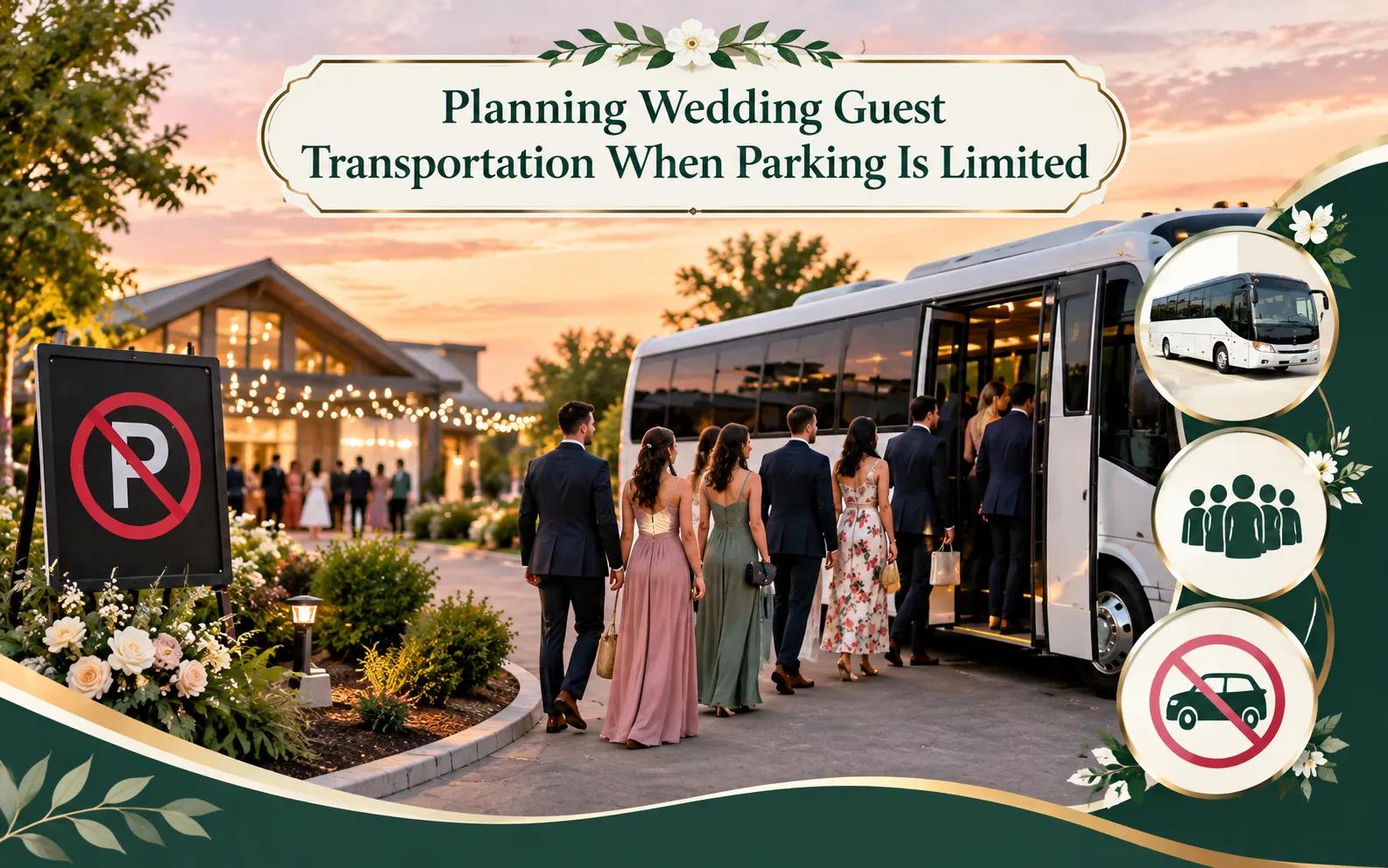
Planning Wedding Guest Transportation When Parking
Limited parking can create a transportation challenge even when everything else about a wedding venue is perfect. A charming estate, vineyard, barn, garden, historic property, or private venue may offer an ideal setting but lack enough space for every guest to park. When a large number of people arrive within the same short period, the result can be crowded entrances, parking confusion, and delayed guests. A well-organized parking-friendly wedding guest transportation plan can help reduce the number of vehicles at the venue while giving guests a reliable and convenient way to attend the celebration.

Start by Understanding the Parking Shortage
Before arranging transportation, determine how much parking the venue can actually provide for guests. The total size of a parking lot does not always represent the number of spaces available for wedding attendees.
Some areas may need to remain available for caterers, photographers, DJs, wedding planners, rental companies, venue staff, and other vendors. The wedding party may also require several spaces, while certain areas may need to stay clear for emergency access.
Ask the venue for a realistic estimate of guest parking capacity on the wedding date. Knowing the true number of available spaces gives you a starting point for determining how many guests may need an alternative transportation option.
Estimate How Many Vehicles Guests Will Bring
The number of wedding guests is not the same as the number of vehicles. Some couples will share rides, families may arrive together, and several guests may stay at the same hotel or vacation rental.
Instead of assuming one car per guest, consider the likely transportation habits of your group. Look at where guests are staying and whether certain groups can reasonably travel together.
Once you have an estimate of the number of vehicles, compare it with the venue's available parking. This can show whether the problem can be solved with basic carpooling or whether a more structured shuttle plan is necessary.
Consider an Off-Site Parking Solution
When on-site parking cannot handle the guest count, an off-site parking location can be an effective solution. Guests can drive to a designated parking area and then take a shuttle to the wedding venue.
The off-site lot could be located at a nearby hotel, church, business property, community facility, public parking area, or another suitable location. The most important factors are distance, accessibility, available space, and permission to use the property.
Moving guest vehicles away from the venue can significantly reduce congestion and make the arrival process more predictable.
Choose the Location With Guest Convenience in Mind
The off-site parking area should be easy for guests to find and reasonably close to the venue. A parking lot that is too far away can increase transportation time and require additional shuttle vehicles.
Look for a location with clear entrances, adequate parking spaces, a safe boarding area, and reasonable lighting. Guests should not have to navigate a confusing series of roads just to find where the shuttle will depart.
The transportation provider should also be able to enter and leave the lot without difficulty. Adequate space for turning, loading, and unloading can help keep the shuttle moving efficiently.
Confirm Permission Before the Wedding
Never assume a nearby parking area is available simply because it appears empty. The property owner or manager should approve the wedding parking arrangement before the location is shared with guests.
Confirm the date, parking hours, expected number of vehicles, shuttle access, and any restrictions that could affect the plan. If the wedding continues into the evening, make sure guests will still be able to access their cars after the reception.
Resolving these details ahead of time helps avoid last-minute changes and keeps the transportation plan dependable.
Build the Shuttle Schedule Around the Arrival Window
A wedding transportation schedule should be based on when guests actually need to arrive at the venue. Start with the ceremony time and work backward to determine when guests should park and board.
The schedule should account for parking, walking to the shuttle, boarding, travel time, and arrival at the venue. Giving guests only a few minutes between parking and ceremony seating can create unnecessary stress.
A well-planned arrival window also helps spread guests across several shuttle departures. Rather than having everyone wait for one vehicle, a scheduled service can create a steady flow of passengers to the venue.
Choose the Right Shuttle Capacity
Vehicle selection depends on the number of guests, route length, and frequency of departures. A smaller wedding may need only a minibus or compact shuttle, while a larger event may require a higher-capacity coach.
A short route between an off-site lot and the venue may allow the same vehicle to make several trips. A longer route can require more vehicles to maintain the same arrival schedule.
The transportation provider should know the parking location, venue address, estimated passenger count, and desired arrival window before recommending vehicle capacity.
Create a Clearly Marked Drop-Off Area
Once guests arrive at the venue, the shuttle needs a practical place to unload them. Limited parking can make this difficult if every available area is already being used by private cars and vendors.
Work with venue staff to identify a designated drop-off location. The area should allow the vehicle to approach, stop safely, unload passengers, and leave without blocking emergency routes or vendor operations.
Keeping the drop-off area clearly defined makes it easier for both drivers and guests to know where transportation belongs.
Consider Accessibility
An off-site parking solution should work for all guests, not just those who are comfortable walking or standing for longer periods.
Older guests and passengers with mobility needs may have difficulty walking from a remote parking area to the shuttle. The boarding location should ideally provide a stable surface and a manageable route.
At the venue, the shuttle should stop somewhere that allows passengers to reach the entrance conveniently. Any accessibility requirements should be communicated to the transportation provider before the wedding so appropriate arrangements can be considered.
Prepare for the Arrival Rush
The busiest transportation period is usually the time shortly before the ceremony. Even a parking lot with adequate capacity can become difficult to manage when too many vehicles or guests arrive simultaneously.
Clear communication can help spread out the arrival process. Guests should know where to park and when shuttle departures are scheduled.
Encouraging guests to arrive earlier can also reduce pressure on the parking area. A comfortable arrival window gives passengers time to park, find the shuttle, and reach the venue without rushing.
Plan for the End of the Wedding
The transportation plan should include the return trip to the off-site parking location. Guests may leave at different times, so one final shuttle may not be enough.
Consider scheduling an earlier return for guests who want to leave after dinner and another departure closer to the end of the reception. This gives guests more flexibility while keeping the transportation system organized.
Return information should be communicated before the wedding and reinforced during the reception. Guests should know where the shuttle will depart and what times are available.
Think About Evening Conditions
If the reception ends after dark, make sure both the venue pickup area and off-site parking location are adequately lit. Guests need to find the shuttle, locate their cars, and walk safely through the parking area.
Lighting is especially important when an overflow lot is located outside a busy commercial or residential area. A covered waiting area can also be helpful if weather changes during the evening.
Assign a Transportation Coordinator
One person should ideally be responsible for monitoring the shuttle operation. This coordinator can communicate with the driver, venue staff, parking-area manager, and guests.
If a vehicle is delayed or the pickup location changes, the coordinator can share accurate information quickly. Having a central point of contact prevents multiple people from sending conflicting instructions.
Keep Guests Informed
A transportation plan only works when guests understand it. The wedding website should clearly explain where guests should park, where the shuttle boards, how often it departs, and what the return schedule looks like.
A reminder message shortly before the wedding can repeat the parking address, shuttle meeting point, and first departure time. If the location is difficult to find, adding a map or photo can make things even easier.
Simple instructions reduce the number of transportation questions guests need to ask on the wedding day.
Coordinate With the Venue
Venue staff should be involved in the transportation planning process from the beginning. Confirm where vehicles can enter, where they can unload passengers, where they may wait, and where return pickups will occur.
This coordination helps prevent the shuttle from interfering with vendors, catering deliveries, emergency access, or other venue operations.
Have a Backup Plan
Even a carefully planned shuttle system can be affected by traffic, severe weather, construction, or unexpected parking restrictions. Having an alternative plan makes the transportation system more adaptable.
An alternate route, secondary parking location, or additional vehicle option can provide flexibility if the original arrangement changes. Guests should know who to contact if an update becomes necessary.
Review Everything Before the Wedding
A final transportation review should confirm the parking location, guest estimate, shuttle capacity, departure schedule, venue drop-off area, accessibility arrangements, and return transportation.
Also check for any changes to the guest list or accommodations. Even a small change can affect the transportation schedule.
A final review gives the transportation provider, venue, and coordinator the same updated information before the event begins.
Final Thoughts
Planning wedding guest transportation when parking is limited requires more than simply booking a shuttle. The most effective plan starts by understanding the venue's true parking capacity and estimating how many guest vehicles need an alternative.
From there, couples can secure an appropriate off-site parking location, choose a shuttle capacity that fits the route, establish clear pickup and drop-off points, and create a realistic arrival and return schedule. Accessibility, lighting, weather, and communication should also be considered.
When every part of the transportation process is planned in advance, limited parking becomes a manageable logistical issue rather than a wedding-day obstacle. A dependable shuttle system can reduce traffic, simplify guest arrivals, and help everyone reach the celebration comfortably without spending the day worrying about where to park.