

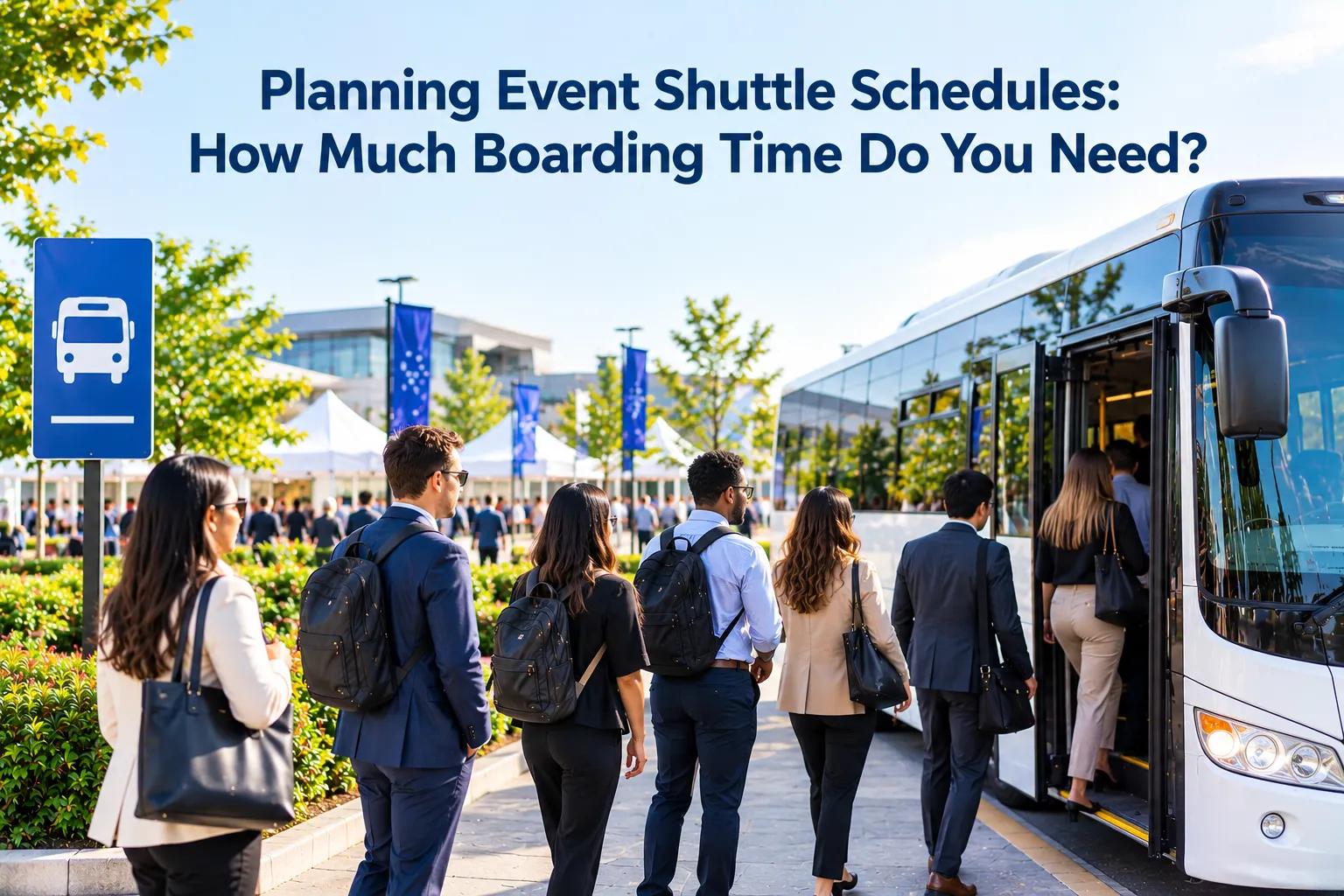
Planning Event Shuttle Schedules: How Much Boarding Time
Planning transportation for a large event requires more than calculating the driving distance between a hotel and venue. One of the most important factors is understanding how long passengers need to board before a shuttle can safely depart. Even when a vehicle arrives on time, guests may need additional minutes to gather, queue, store belongings, receive assistance, and find their seats. Understanding event shuttle boarding time can help planners create more realistic schedules, reduce delays, and keep transportation running smoothly throughout the event.

Why Boarding Time Matters in Event Transportation
Boarding time is a key part of the complete shuttle cycle. A bus may require only 20 minutes to travel between two locations, but that does not mean it can complete a new trip every 20 minutes. Passengers must first board, and the vehicle may also need time for unloading, staging, traffic, and repositioning.
When a shuttle operates repeatedly, even a small boarding delay can affect later departures. A five-minute delay on one trip can become a much larger scheduling problem after several cycles. For this reason, transportation planners should estimate boarding time before determining departure frequency.
Federal Highway Administration guidance on special-event shuttle operations also emphasizes passenger loading and unloading time, route service time, and peak arrival rates when determining appropriate shuttle capacity.
Start With Passenger Demand
The number of passengers expected during each departure window is one of the most important considerations. Total event attendance does not necessarily represent the number of people who need transportation at the same time.
For example, a conference may have 1,000 attendees but only a portion may use hotel shuttles during a particular period. However, a large number of guests may suddenly arrive at the pickup location shortly before a keynote or opening session.
Planners should therefore examine transportation demand in smaller time periods. Looking at 15- or 30-minute windows can reveal peak passenger demand that an average hourly estimate might hide. This approach can help determine whether additional buses are needed during the busiest periods.
Consider the Size of the Vehicle
Vehicle capacity and boarding time are closely connected. A smaller shuttle may load a limited number of passengers relatively quickly, while a full-size motorcoach may require more time when carrying a large group.
The objective should not simply be to select the vehicle with the largest seating capacity. Planners need to consider how many passengers must be moved during each transportation window and how quickly the selected vehicles can complete their cycles.
A larger bus may reduce the number of trips required, but if every departure is completely full, passenger loading could take longer. Multiple smaller vehicles may sometimes provide more frequent departures and greater flexibility.
Estimate the Actual Boarding Window
The boarding window should begin before the scheduled departure time. Guests need an opportunity to reach the loading area, form an organized queue, and enter the vehicle.
For smaller groups, boarding may take only a few minutes. Larger groups can require considerably longer, especially when passengers have luggage, equipment, children, or mobility considerations.
There is no universal boarding time that applies to every event. A practical estimate should reflect the specific group, vehicle, venue, and transportation conditions. A full motorcoach carrying a large group should generally be given more loading time than a smaller shuttle carrying a handful of passengers.
Account for Luggage and Personal Belongings
Luggage can significantly affect boarding time. Airport transportation, hotel transfers, corporate events, sports competitions, and multi-day conferences may involve passengers carrying larger bags or equipment.
If luggage must be placed in an undercarriage compartment, loading continues even after passengers begin taking their seats. When the driver is responsible for managing every bag, this can extend the vehicle's curbside dwell time.
Event staff or a dedicated luggage attendant can help coordinate this process. Keeping passenger movement and luggage handling organized can reduce unnecessary delays and make departures more predictable.
Consider Accessibility Requirements
Accessibility needs should be included in the original schedule rather than treated as an unexpected delay. Passengers using wheelchair lifts or requiring additional boarding assistance may need more time to enter and secure their equipment safely.
Planners should communicate accessibility requirements to the transportation provider before the event. This allows appropriate vehicles to be assigned and gives the transportation team enough time to accommodate passengers without rushing.
A reliable schedule should prioritize safe and comfortable boarding rather than attempting to meet an unrealistic departure time.
Evaluate the Pickup Location
The location of the shuttle stop can have a major impact on boarding time. A dedicated hotel loading area may allow passengers to move directly from the lobby to the vehicle, while a convention center or stadium may involve longer walking distances and heavier pedestrian traffic.
Venue access rules should also be reviewed before the event. Some locations may have designated bus lanes, restricted curb access, staging areas, or limited dwell times.
The loading area should provide enough space for passengers to queue safely and for buses to enter and leave without creating conflicts with pedestrians or other vehicles. Federal event-transportation guidance specifically recommends considering boarding locations, pedestrian routing, and the ability to load or unload multiple buses simultaneously.
Use the Event Agenda to Build the Schedule
A shuttle schedule should be connected to what is happening inside the venue. Transportation demand often increases shortly before sessions, ceremonies, meetings, performances, and other major program elements.
Instead of simply operating buses at the same interval all day, planners can adjust service based on the event agenda. A quiet midday period may require fewer vehicles, while the 30 to 45 minutes before a major session may require additional capacity.
This approach makes the transportation operation more responsive to actual passenger demand.
Calculate the Complete Shuttle Cycle
Boarding time should be combined with driving, unloading, return travel, staging, and recovery time to calculate the complete route cycle.
For example, imagine that passengers need eight minutes to board, the trip to the venue takes 18 minutes, unloading requires four minutes, and the return journey takes 16 minutes. The bus also needs some time to reposition before starting another trip.
The total cycle is therefore much longer than the 18-minute one-way drive. Understanding this complete cycle helps planners determine how frequently one vehicle can realistically operate.
Charter Buses USA similarly emphasizes calculating complete route-cycle time by considering driving, passenger boarding, unloading, traffic, and turnaround requirements.
Add Buffer Time for Delays
Event-day conditions rarely match a perfect schedule. Traffic congestion, weather, late passengers, venue restrictions, security procedures, and crowded loading areas can all increase transportation time.
A practical buffer helps absorb minor delays without disrupting the entire schedule. The amount of buffer should depend on the route, venue, passenger volume, and time of day.
The busiest periods deserve particular attention. If one shuttle falls behind during a major departure wave, passengers waiting for subsequent vehicles may quickly form a large queue.
Organize Passengers Before Boarding
Passenger organization can make the boarding process more efficient. Clear signs should identify each shuttle route or destination, particularly when several vehicles are serving different hotels or locations.
Event staff can direct passengers into appropriate queues before the buses arrive. Questions about tickets, registration, or destinations can also be handled away from the vehicle door whenever possible.
This allows passengers to approach the bus prepared to board instead of stopping at the entrance and delaying everyone behind them.
Test the Schedule Before the Event
A rehearsal can provide valuable information about whether the estimated boarding time is realistic. Organizers can use staff or volunteers to simulate passenger loading and measure the time required.
The test can also identify problems with the pickup location. Perhaps passengers have difficulty finding the loading zone, the curb cannot accommodate multiple buses, or luggage takes longer to load than expected.
Making these adjustments before the event can prevent avoidable problems on the actual day.
Monitor Actual Boarding Times
Even after testing, planners should monitor the first departures during the event. Actual passenger behavior may differ from the rehearsal.
If the first few trips consistently take longer than expected, transportation staff can adjust later departures, add vehicles, or modify passenger queues where possible.
Recording actual boarding times can also improve future transportation planning. Event organizers can use this information to create more accurate schedules for recurring conferences, festivals, weddings, corporate events, or sporting programs.
Communicate the Schedule Clearly
Passengers should receive transportation information before they arrive at the event. Pickup locations, departure windows, shuttle destinations, and instructions for boarding should be easy to understand.
Providing the same information through event websites, registration materials, email reminders, venue signage, and staff announcements can reduce confusion.
When passengers know where to go and when to arrive, the boarding process becomes more predictable and the transportation team can maintain the schedule more effectively.
Conclusion
Determining how much boarding time an event shuttle needs is an essential part of reliable transportation planning. Passenger volume, vehicle size, luggage, accessibility requirements, pickup location, and event timing can all influence how long a vehicle needs to remain at the curb.
The best approach is to calculate boarding as part of the complete shuttle cycle rather than treating it as a minor detail. By analyzing peak passenger demand, testing boarding times, organizing loading areas, communicating clearly with guests, and allowing practical scheduling buffers, event planners can build transportation plans that are more realistic and dependable.
A well-planned shuttle schedule helps reduce passenger waiting, improves vehicle utilization, and prevents small boarding delays from becoming major event-day disruptions. When boarding time is estimated accurately from the beginning, the entire transportation operation becomes smoother, safer, and easier to manage.