

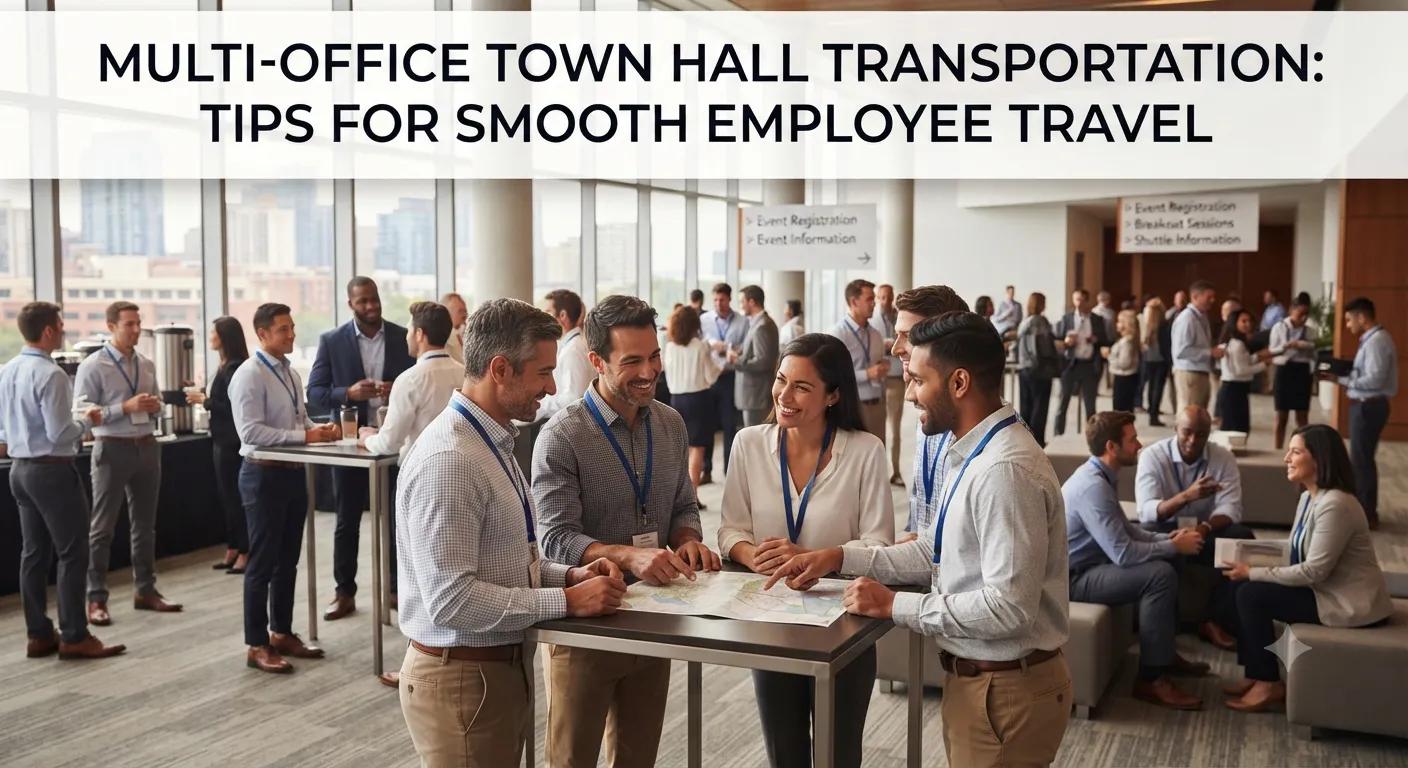
Multi-Office Town Hall Transportation: Tips for Smooth
Company-wide town halls bring employees together to discuss business updates, leadership priorities, organizational achievements, and future goals. When employees are traveling from multiple offices, getting everyone to the same venue requires more than simply booking a few vehicles. Careful multi-office employee travel planning can help companies organize routes, coordinate schedules, and provide employees with a smoother travel experience from their office to the town hall and back.

Understand Where Employees Are Traveling From
Before arranging transportation, determine which offices will participate in the town hall and how many employees are expected from each location. A company may have a headquarters, regional offices, satellite facilities, or other workplaces spread across different areas.
Each location can have different transportation requirements. One office may have a large number of attendees and need dedicated transportation, while a smaller nearby office may be able to share a vehicle with another location.
Collecting accurate attendance information early provides a better foundation for determining routes, vehicle capacity, and pickup schedules.
Choose Convenient Pickup Locations
Employees should not have to guess where they need to meet their transportation. Every participating office should have a clearly defined pickup location that is easy to access and recognize.
The main entrance may work well for some offices, while others may need to use a parking area or nearby designated location because of traffic restrictions. The pickup point should provide enough space for employees to gather and for buses to load passengers safely.
Clear instructions about pickup locations can reduce delays and help drivers keep the overall schedule on track.
Match Vehicle Capacity to Employee Demand
The number of employees traveling from each office should influence the type and number of vehicles selected. Smaller groups may be comfortable using minibuses, while larger groups may require full-size charter buses.
Companies should avoid planning transportation based solely on total town hall attendance. Some employees may drive independently or make their own travel arrangements, so the actual number of transportation users is more important when determining capacity.
It can also be helpful to maintain some flexibility for attendance changes. Employee schedules can change before the event, and transportation plans should allow reasonable adjustments when possible.
Build Routes That Keep Travel Times Reasonable
Multi-office transportation often requires several routes. Nearby offices may be combined into one route when doing so does not create excessive travel time for employees.
The number of stops should be carefully considered. Adding too many pickup locations to a single route may reduce the number of vehicles required, but it can also make the journey considerably longer for passengers.
Route planning should balance efficiency, employee convenience, and the expected arrival time at the town hall venue. A transportation provider can also help review proposed routes and identify potential logistical concerns.
Create a Schedule With Extra Time
The town hall schedule should determine when transportation needs to arrive at the venue. However, buses should not be scheduled to arrive only a few minutes before the program begins.
Employees need time to leave the vehicle, enter the venue, find their seats, and prepare for the event. Traffic and boarding delays should also be considered when determining departure times.
Working backward from the desired arrival time can help planners establish practical departure schedules for each office. Locations farther from the venue may require significantly earlier departures than nearby offices.
Coordinate With the Event Venue
The transportation plan should account for the venue's access requirements. Confirm where buses can enter, where passengers can be dropped off, and whether vehicles have a designated staging or parking area.
This becomes especially important when several buses are expected to arrive around the same time. Without a coordinated arrival plan, vehicles may encounter limited curb space or difficulty accessing the appropriate entrance.
Sharing venue details with drivers and the transportation provider in advance can make arrivals more organized and reduce unnecessary confusion.
Keep Employees Informed
Good transportation planning depends on clear employee communication. Employees should receive their transportation details well before the town hall so they have enough time to make arrangements around the schedule.
Information should include the pickup location, departure time, expected arrival, and return transportation details. Employees from different offices may have different schedules, so location-specific instructions are often easier to understand than one general transportation announcement.
A reminder shortly before the event can reinforce the schedule and encourage employees to arrive at their pickup point early.
Assign a Transportation Coordinator
A central transportation coordinator can make multi-office travel much easier to manage. This person can serve as the main contact for the transportation provider, venue, office managers, and employees.
For larger organizations, each office can also designate a local transportation contact. These individuals can help employees gather at the correct pickup location and communicate urgent updates to the central coordinator.
Having clearly defined communication responsibilities helps prevent conflicting instructions and makes it easier to respond if something changes.
Plan the Return Transportation
The journey home should receive the same level of attention as the trip to the town hall. Corporate events can sometimes run longer than expected because of presentations, employee questions, networking, or other activities.
Before the event begins, employees should know where to go for their return transportation and which vehicle they should use. If different offices have separate return routes, make sure each group receives the appropriate instructions.
For employees traveling long distances, planners should also consider how the return schedule affects their evening and the following workday.
Prepare for Unexpected Changes
Traffic, weather, employee attendance, and event timing can all affect a transportation plan. Having a clear process for handling changes allows organizers to respond more efficiently.
The transportation coordinator should know how to contact drivers and office representatives if a schedule needs to change. Employees should also have access to a reliable source for transportation updates.
Allowing reasonable flexibility in the schedule can help minimize the effect of unexpected delays without disrupting the entire town hall.
Consider Comfort and Accessibility
Employee transportation should be planned with the needs of the entire workforce in mind. If an employee requires accessible transportation or additional boarding assistance, those requirements should be communicated to the transportation provider ahead of time.
For longer journeys, employee comfort can also influence the overall experience. Depending on the vehicle and trip, features such as comfortable seating, climate control, storage, and Wi-Fi can make group travel more convenient.
A transportation plan that considers accessibility and comfort can help employees arrive ready to participate in the town hall.
Final Thoughts
Smooth employee travel for a multi-office town hall depends on careful coordination between office locations, attendance numbers, vehicle capacity, routes, schedules, and venue requirements. Starting the planning process early allows companies to make adjustments before the event and communicate transportation details clearly.
By establishing convenient pickup locations, creating realistic schedules, coordinating with the venue, and maintaining a clear communication process, companies can make transportation a seamless part of the town hall experience. Employees can travel together efficiently while event organizers focus on delivering a productive and engaging company-wide meeting.