

How to Reduce Deadhead Mileage Costs for Group Travel
Planning group transportation involves more than choosing a bus and calculating the distance between two locations. Transportation companies must also consider the distance their vehicles travel before picking up passengers and after completing a trip. These empty journeys, commonly known as deadhead mileage, can influence the total cost of a charter bus rental. Understanding how to reduce empty bus mileage expenses can help businesses, schools, event planners, and travel coordinators manage transportation budgets more effectively.

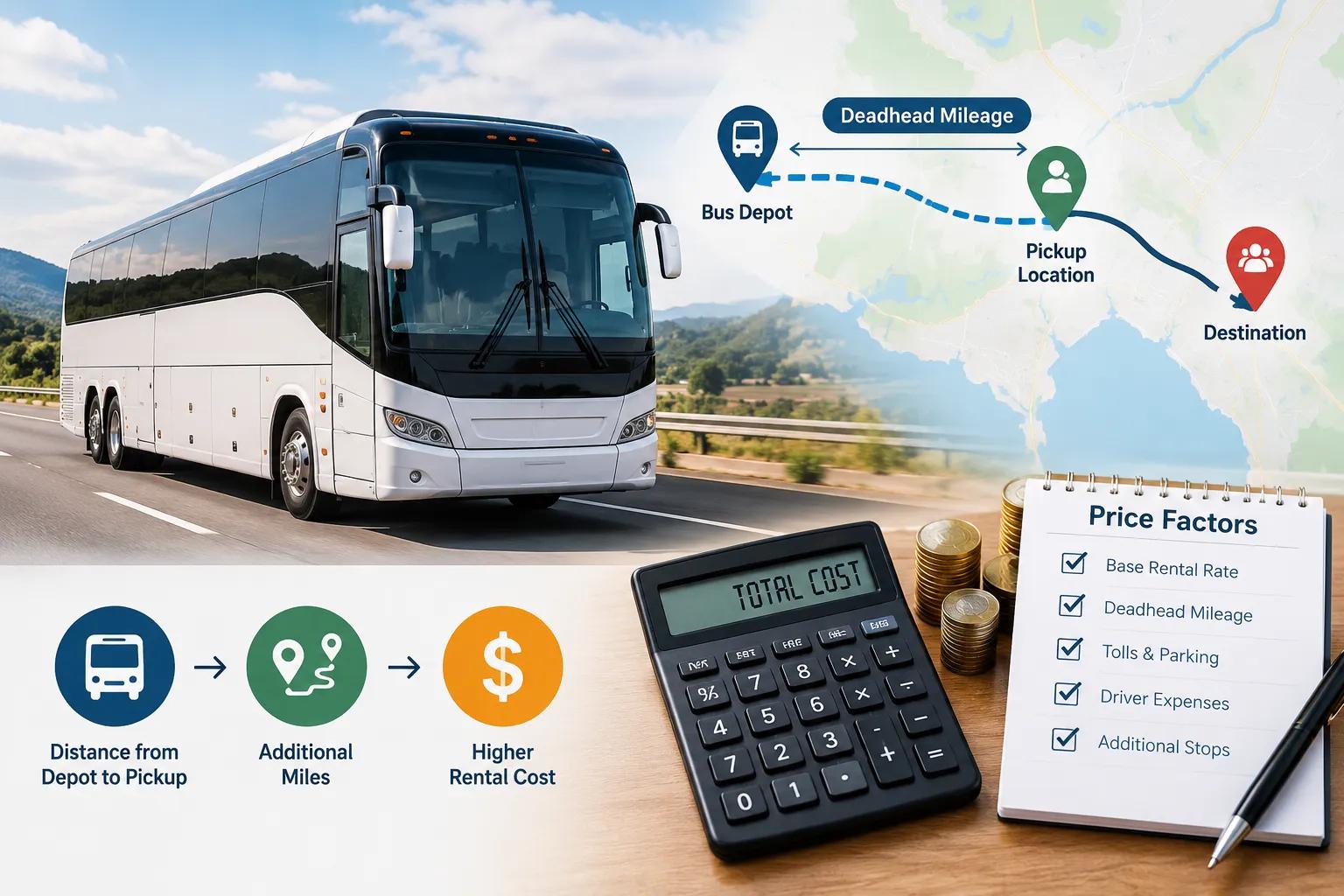
Deadhead mileage generally occurs when a charter bus travels from its garage to the pickup location or returns to its operating base after dropping off passengers. Even without passengers onboard, the vehicle consumes fuel, requires a driver, and accumulates mileage. By planning routes carefully, choosing suitable transportation providers, and communicating travel requirements clearly, groups can reduce unnecessary empty travel and make better use of their transportation budgets.
Understanding Deadhead Mileage and Its Effect on Group Travel
Deadhead mileage refers to the distance a charter bus travels without passengers during a scheduled service. The distance between a company's garage and the pickup point can affect the overall price, particularly when the vehicle must travel a considerable distance before the journey begins.
For example, a company organizing transportation for 40 employees may need a bus for a conference located 60 miles away. If the available vehicle is based 25 miles from the office, the bus must cover those additional miles before collecting the group. It may also need to return to its base after dropping off the employees.
The total vehicle mileage can therefore be much higher than the distance passengers travel. Depending on the operator's pricing method, these additional miles may affect the hourly rate, mileage charge, or overall trip price.
Understanding this difference allows group organizers to identify opportunities for reducing unnecessary transportation expenses before confirming a booking.
Choose a Charter Bus Company Near Your Pickup Location
One of the most effective ways to reduce deadhead mileage costs is to request quotes from transportation companies with suitable vehicles available near the pickup location.
A nearby bus may require less empty travel before the scheduled departure and after the final drop-off. This can reduce fuel consumption and driver time, potentially lowering the overall cost of the service.
For instance, imagine two charter bus operators are quoting for a local corporate event. One has an available vehicle stationed eight miles from the office, while the other must send a bus from a depot 35 miles away. The first operator may have lower repositioning expenses, although the final quote will also depend on vehicle availability, labor costs, and other service requirements.
When comparing providers, ask where the assigned bus will begin its journey. You should also confirm whether the company calculates pricing from the garage departure time or the scheduled passenger pickup time.
Choosing a nearby operator does not automatically guarantee the lowest price, but it provides a useful starting point for identifying more economical options.
Plan Pickup and Drop-Off Locations Carefully
Accurate pickup and drop-off information helps transportation companies estimate the complete journey more reliably. Vague addresses can make route planning difficult and may result in unnecessary driving or adjustments to the original quote.
Group organizers should provide exact addresses for offices, hotels, schools, airports, event venues, and other relevant locations. If several pickup points are necessary, arrange them in a logical sequence that minimizes unnecessary detours.
For example, a business collecting employees from three nearby offices may be able to coordinate a central meeting point instead. If the arrangement is practical for the passengers, reducing the number of separate pickups can simplify the route and make scheduling more efficient.
The same principle applies to weddings, school excursions, and sporting events. Selecting convenient meeting locations and planning the final drop-off carefully can help the transportation provider avoid unnecessary mileage.
However, pickup consolidation should always account for passenger accessibility, luggage requirements, safety, and the group's actual travel needs.
Coordinate One-Way and Round-Trip Transportation
One-way charter bus rentals can involve substantial deadhead mileage when the vehicle must return to its garage after dropping off passengers. This is one reason a one-way trip may not cost half as much as a round-trip booking.
Suppose a group travels 100 miles to attend a conference and does not require transportation home. The bus may still need to travel another 100 miles to return to its operating base. The operator must account for that empty return journey when calculating the price.
To manage this expense, ask whether the provider has another scheduled booking near the destination. If another customer requires transportation from the same area, the operator may be able to coordinate assignments more efficiently. Any resulting savings depend on scheduling, availability, and the company's pricing policies.
For round-trip transportation, provide the expected return time and explain whether the bus must remain at the venue. In some situations, keeping the vehicle nearby is practical. In others, returning to the garage and dispatching it again later may be more economical.
Requesting a comparison of these arrangements can help you choose the most cost-effective option.
Use Flexible Scheduling When Possible
Transportation demand varies by date, time, location, and vehicle availability. A flexible schedule can sometimes help a charter bus company assign a vehicle that is already operating near the pickup area.
For example, an organization planning a weekday business meeting may have more scheduling flexibility than a group attending an event at a fixed time. If the departure time can be adjusted slightly, the operator may have more options for coordinating the vehicle's previous or subsequent assignment.
The same approach may work for company outings, school trips, and nonessential group activities. Booking early and sharing the complete itinerary gives the provider more time to evaluate available vehicles and plan an efficient schedule.
Flexibility will not always reduce deadhead mileage, particularly when the destination, event time, or passenger schedule is fixed. Nevertheless, discussing reasonable alternatives with the operator may reveal opportunities that are not available when every detail is finalized at the last minute.
Compare Complete Charter Bus Quotes
A low advertised hourly rate does not necessarily mean a lower final transportation cost. Some companies include deadhead mileage in their overall price, while others calculate charges based on vehicle mileage, billable hours, or repositioning expenses.
When reviewing quotes, ask each provider to explain how the price is calculated. Confirm whether the total includes travel from the garage to the pickup location, the return journey after the final drop-off, and any applicable additional mileage charges.
You should also check whether tolls, parking, driver expenses, and other potential costs are included. Comparing these details makes it easier to understand why one provider may charge more than another for a similar itinerary.
For example, a company offering a higher hourly rate might provide a lower total quote because its bus is located closer to the pickup point. Another operator might advertise a lower rate but require more billable hours to cover the empty travel.
A written, itemized quote can help you identify the actual cost of the complete service rather than focusing on a single pricing figure.
Organize Group Travel Requirements in Advance
Poor coordination can create additional driving and scheduling complications. Last-minute changes to pickup points, destination addresses, passenger counts, and departure times may require a transportation company to revise its route or reposition the vehicle.
Group organizers can minimize these complications by confirming the itinerary before requesting final quotes. Share the passenger count, luggage requirements, pickup schedule, destination, expected return time, and any planned stops.
For corporate events, coordinate transportation details with the venue and event management team. For schools and sports organizations, confirm arrival times, equipment requirements, and return arrangements with the responsible staff.
Providing complete information allows the operator to select an appropriate vehicle and develop a realistic schedule. It also reduces the likelihood of avoidable route changes that may increase mileage or operating time.
Although advance planning cannot eliminate every empty mile, it can make the transportation arrangement more predictable and efficient.
Consider the Total Value of the Transportation Service
Reducing deadhead mileage is important, but the lowest possible price should not be the only consideration when choosing a charter bus company.
Vehicle capacity, passenger comfort, maintenance standards, insurance arrangements, driver qualifications, and scheduling reliability also influence the value of a rental. Selecting an unsuitable vehicle or an unreliable provider may create additional complications that outweigh modest initial savings.
Instead, compare the complete cost with the quality and suitability of the service. A nearby operator with the right vehicle and a clear pricing structure may provide better value than a company offering a lower advertised rate with significant additional charges.
Ask questions whenever the quote is unclear, and confirm all important arrangements in writing before making a reservation.
Conclusion
Deadhead mileage can affect group transportation costs because charter buses often need to travel without passengers before reaching the pickup location or after completing a trip. Fuel consumption, driver time, vehicle maintenance, and scheduling requirements all contribute to these expenses.
Group organizers can reduce unnecessary empty travel by choosing providers with nearby vehicles, supplying accurate addresses, coordinating pickup locations, considering flexible schedules, and comparing complete written quotes. Discussing one-way return arrangements and asking about nearby bookings may also reveal opportunities for more efficient transportation planning.
Whether you are organizing a corporate conference, school excursion, wedding, sports trip, or private group outing, understanding deadhead mileage helps you make informed decisions about your budget. Careful planning and clear communication with Charter Buses USA can help you evaluate suitable transportation options and arrange a service that meets your group's travel requirements.