

How to Plan Transportation for Company Town Halls Across Multiple Office Locations
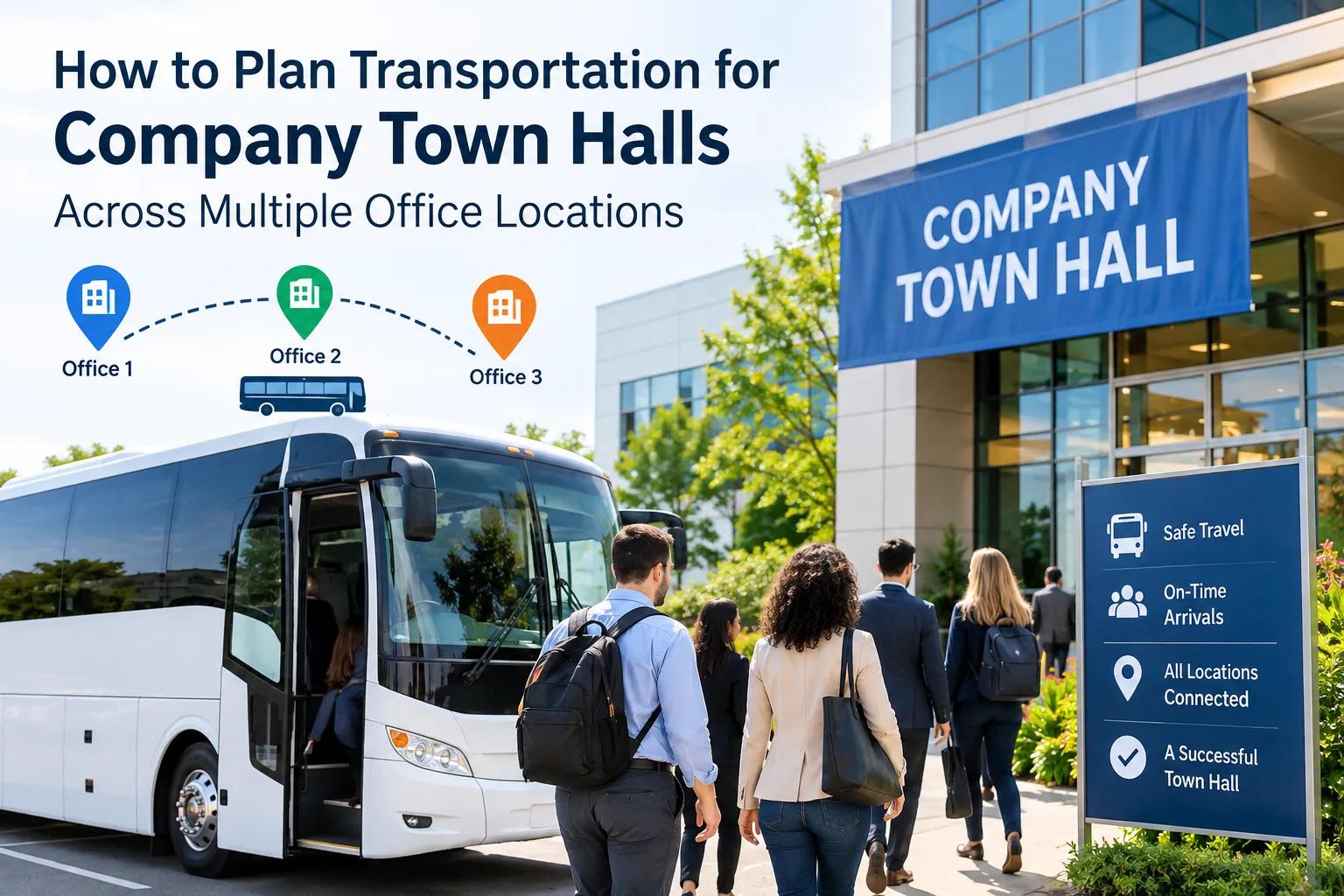
How to Plan Transportation for Company Town Halls Across
Company town halls bring employees together for important announcements, leadership updates, training, and organizational discussions. When employees work across several office locations, however, getting everyone to one venue can become a significant logistical challenge. Coordinating different arrival times, office distances, parking limitations, and employee transportation needs requires careful planning. A well-organized transportation strategy can make the event more punctual, comfortable, and productive.
For companies preparing a multi-location town hall, multi-office corporate transportation planning can provide a practical way to coordinate employees from different workplaces. Instead of asking everyone to drive separately or arrange individual rides, companies can create a centralized transportation plan that moves groups efficiently to the event venue.

Start With Employee Locations and Attendance
The first step is understanding where employees will be traveling from and how many people are expected to attend. Create a list of participating offices and estimate attendance from each location. This information gives the planning team a clearer picture of transportation demand.
Attendance should be separated by office rather than treated as one large number. For example, a company with offices in three cities may have 100 employees attending from one location, 60 from another, and 40 from a smaller office. Each group may require a different vehicle size, departure time, or route.
It is also important to account for employees who may travel from home rather than their normal office. A town hall can change regular work patterns, particularly when employees are asked to report directly to a central venue.
Choose a Central and Accessible Venue
The location of the town hall has a major effect on transportation planning. A venue that is reasonably accessible from multiple offices can reduce travel time and simplify scheduling.
When evaluating a location, consider highway access, parking availability, bus loading areas, traffic patterns, and the distance between the venue entrance and designated drop-off points. A venue may look convenient on a map but become difficult for large vehicles during peak traffic.
Companies should also confirm whether the venue permits charter buses to enter the property and where vehicles can safely load and unload passengers. Addressing these questions before the event prevents unnecessary delays on the day of the town hall.
Build Routes Around Office Locations
Once attendance and venue details are confirmed, transportation routes can be developed around the participating offices. The goal should be to create efficient routes without making employees spend excessive time traveling to additional pickup locations.
For companies with several nearby offices, combining employees into a shared route may make sense. Separate transportation may be more appropriate when offices are located far apart or have significantly different event schedules.
Route planning should consider normal traffic, construction, toll roads, expected congestion, and potential delays. The schedule should include enough buffer to help employees arrive before the town hall begins rather than arriving at the exact start time.
Select Vehicles Based on Actual Demand
Vehicle capacity should reflect the number of employees traveling from each location. A small group may be better suited to a minibus, while a larger office may require a full-size charter bus or multiple vehicles.
Avoid selecting vehicles based solely on total attendance. If 200 employees are attending but they are spread across five offices, transportation may need to be divided into several routes rather than placing everyone on a single large vehicle.
Comfort also matters. Town halls can involve long presentations and demanding schedules, so employees benefit from transportation that gives them a comfortable place to sit, relax, and prepare for the event. Depending on the trip length and vehicle type, amenities such as climate control, reclining seats, overhead storage, and onboard Wi-Fi can improve the experience.
Coordinate Departure Times Carefully
Departure times should be calculated backward from the town hall start time. Instead of asking what time employees should leave their offices, determine when they need to arrive at the venue and work backward based on expected travel time.
For example, if registration begins at 8:30 a.m. and the town hall starts at 9:00 a.m., transportation should arrive early enough to allow employees to exit the bus, enter the venue, register, and find their seats without rushing.
Different offices may require different departure times. An office located 30 minutes away should not necessarily depart at the same time as an office two hours from the venue. Creating location-specific schedules keeps the transportation plan more efficient.
Communicate the Schedule in Advance
Even an excellent transportation plan can fail if employees do not know where and when to board. Communication should begin well before the event.
Employees should receive clear information about their assigned pickup location, departure time, expected arrival time, vehicle identification, and contact information for transportation-related questions. If reservations or signups are required, the registration process should be simple and accessible.
Sending reminders closer to the event can also reduce missed departures. A final communication can confirm the schedule and remind employees to arrive at their pickup point several minutes before the scheduled departure.
Plan for Accessibility and Special Requirements
Accessibility should be included in the transportation plan from the beginning rather than handled as a last-minute request. Companies should identify employees who may require accessible boarding or additional accommodations and confirm that the selected transportation provider can meet those needs.
This is particularly important when employees are traveling from multiple offices because each location may have different boarding conditions. Pickup areas should be accessible, safe, and suitable for the assigned vehicle.
Companies should also consider other practical requirements, including luggage or equipment, employee mobility needs, and special event materials that may need to travel with the group.
Prepare for Traffic and Unexpected Delays
Multi-office town halls often involve transportation across different highways, cities, or regions. Traffic conditions can change quickly, making contingency planning essential.
Transportation coordinators should review typical traffic patterns for the event day and identify alternative routes where practical. Drivers and transportation providers should also have clear instructions regarding communication if a delay occurs.
It is better to build reasonable time buffers into the schedule than to create an extremely tight itinerary that leaves no room for unexpected congestion. The objective is not simply to minimize travel time but to create a reliable arrival window.
Create a Single Transportation Coordinator
When several offices are involved, assigning one person or team to oversee transportation can prevent confusion. The coordinator can communicate with office managers, employees, the event venue, and the transportation provider.
Each office can still have a local contact, but there should be one central source of information for schedule changes and transportation decisions. This becomes especially valuable if weather, traffic, venue changes, or attendance adjustments require last-minute updates.
A centralized system also makes it easier to track vehicles and confirm that every participating office has transportation coverage.
Review the Plan After the Town Hall
Transportation planning should not end when the buses return employees to their offices. After the event, gather feedback from employees and event organizers.
Ask whether pickup locations were convenient, whether departure and arrival times worked as expected, whether vehicles provided enough capacity, and whether communication was clear. This feedback can improve transportation planning for future town halls, conferences, training sessions, and company-wide meetings.
For organizations that regularly hold multi-location events, maintaining a record of successful routes, preferred venues, travel times, and employee feedback can make future planning considerably easier.
Make Multi-Office Town Hall Transportation More Efficient
Bringing employees together from multiple offices requires more than simply booking a bus. Successful transportation planning combines accurate attendance information, efficient routes, appropriate vehicle capacity, realistic schedules, clear communication, accessibility planning, and contingency preparation.
With the right strategy, companies can reduce transportation-related stress and give employees a smoother experience from their office departure to the town hall venue. A professional group transportation solution can also help event organizers focus on the purpose of the meeting instead of managing dozens of individual travel arrangements.
When transportation is planned around the actual needs of each office location, a multi-location company town hall can become easier to coordinate, more organized, and more comfortable for everyone attending.