

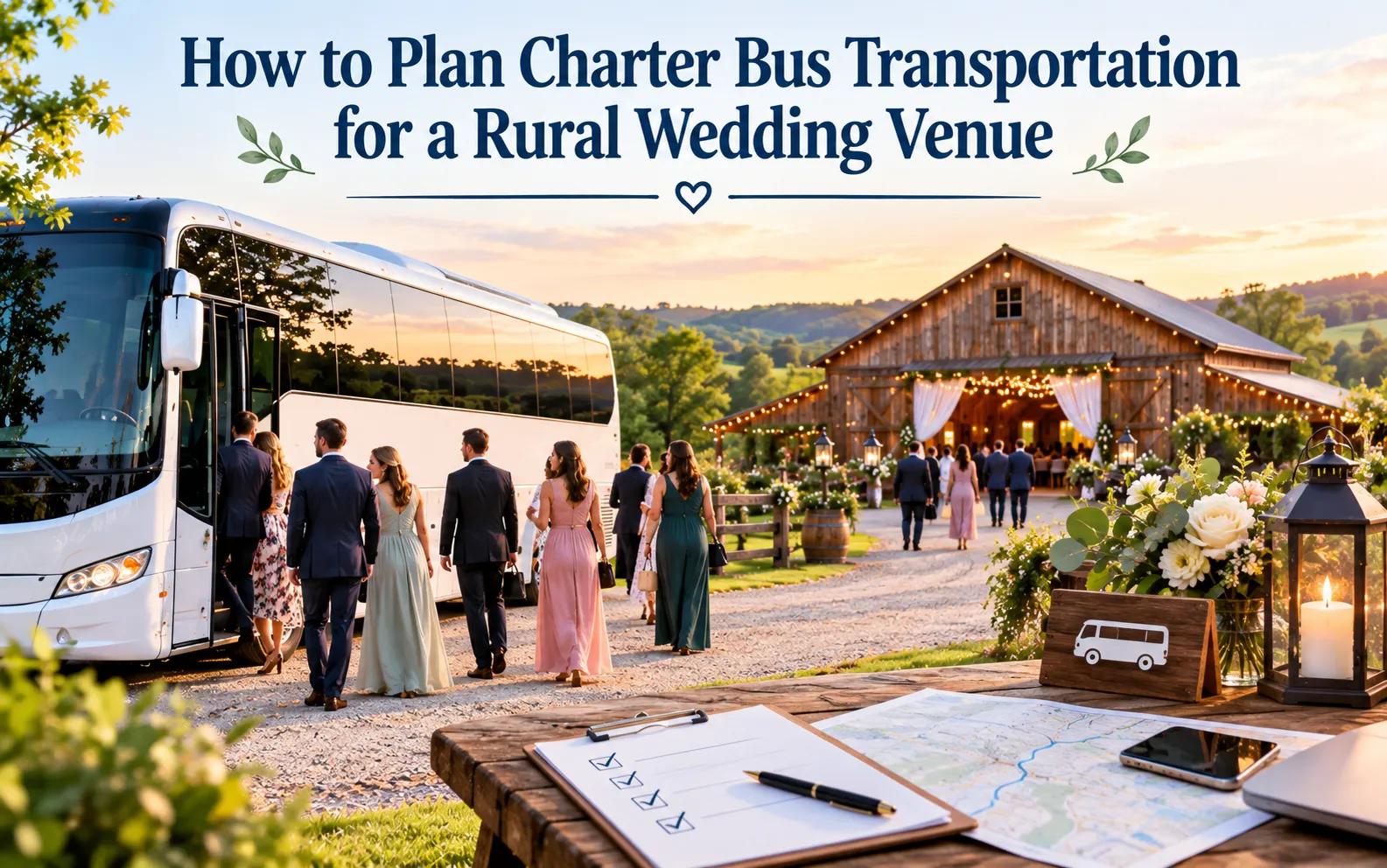
How to Plan Charter Bus Transportation for a Rural Wedding
Planning a wedding at a rural venue can create a beautiful and intimate celebration, but transportation requires more preparation than it often does at an easily accessible hotel or city venue. Narrow roads, gravel driveways, limited parking, low branches, and long distances from nearby hotels can all affect how guests reach the property. When arranging rural wedding transportation, it is important to evaluate the venue and route before choosing a vehicle. Couples can also review this guide to wedding bus access for additional questions to discuss with the venue and transportation provider.

Start With the Venue’s Location and Access
The first step in planning charter bus transportation is understanding exactly how guests and buses will reach the wedding venue. A location may be easy for personal vehicles to reach but difficult for a large passenger vehicle.
Ask the venue coordinator about the route from the nearest major highway. Find out whether the final portion of the trip includes narrow roads, steep hills, gravel lanes, bridges, gates, or sharp turns. These details can influence whether a full-size motorcoach, minibus, or another vehicle is appropriate.
Do not rely entirely on standard GPS directions. Navigation systems may recommend routes that work for cars but are unsuitable for larger vehicles. The transportation provider should review the actual route before the wedding.
Check the Final Mile to the Property
For rural weddings, the final mile can be one of the most important parts of transportation planning. A charter bus may travel comfortably on major highways but encounter problems once it turns onto a private road or farm lane.
Ask about the width and surface of the road leading to the venue. Determine whether the lane is paved, gravel, dirt, or grass and whether vehicles can safely pass each other. If the route includes a narrow bridge, ask about posted weight restrictions.
It is also helpful to request current photos of the road, entrance, driveway, and turnaround area. Sharing these photos with your transportation provider can help the driver understand what to expect.
Determine Which Bus Size Fits the Venue
The number of guests is important when selecting a charter bus, but it should not be the only consideration. Rural access conditions may determine which vehicle can safely reach the property.
A full-size charter bus may be suitable when the roads are wide, the entrance is accessible, and there is sufficient room for the vehicle to turn around. A smaller minibus may be more practical when the venue has tight roads or limited maneuvering space.
If no large vehicle can reach the property, consider establishing a pickup point at a nearby paved parking area. Guests can then transfer to a smaller vehicle for the final portion of the journey.
The goal is to select a vehicle based on both passenger capacity and actual road conditions.
Confirm Bus Turning and Staging Areas
A charter bus needs more than an entrance. It also needs enough space to turn around or safely wait while guests attend the ceremony and reception.
Ask the venue where the bus can stage between trips. If the property has a large parking lot or circular driveway, the transportation provider can evaluate whether it provides enough room for the selected vehicle.
Avoid relying on a plan that requires a large bus to reverse a long distance down a narrow driveway. A designated turnaround area provides a more practical solution and can make the driver's job easier.
Look for Overhead and Roadside Obstacles
Rural properties can contain obstacles that are easy to overlook during a venue tour. Low tree branches, utility lines, narrow gates, signs, barn overhangs, and decorative structures can create clearance problems for taller vehicles.
Ask the venue whether any overhead or roadside obstacles exist along the route. Measurements are more useful than descriptions such as "the driveway is pretty wide" or "the trees should be fine."
Your transportation provider should know the exact dimensions of the vehicle being considered. Comparing those dimensions with the narrowest parts of the route can help identify potential problems before the wedding day.
Plan the Guest Drop-Off Area
Guest convenience should be part of the transportation plan. Rural venues may have uneven ground, gravel paths, hills, or long distances between the parking area and ceremony space.
Ask where the bus will drop guests off and how far they will need to walk. A level area close to the entrance can be particularly helpful for older guests, young children, and anyone with mobility concerns.
The same location should be evaluated for the return trip. Guests leaving after dark should have a clearly marked and accessible pickup area rather than having to walk across an unfamiliar property.
Consider Evening Lighting and Communication
Many rural wedding venues have limited outdoor lighting. This becomes especially important when guests leave the reception late at night.
Ask whether the bus pickup area, driveway, parking area, and walking routes are illuminated. If lighting is limited, discuss temporary lighting or clear signs that can help guests locate the correct vehicle.
Cell service is another consideration. Some rural venues have weak or inconsistent coverage. Establish a communication plan with the venue, transportation provider, wedding coordinator, and drivers before the event. Printed schedules and clear meeting locations can provide useful backup when mobile service is unreliable.
Prepare for Weather Changes
Weather can dramatically affect rural transportation. A gravel road that is easy to navigate during dry conditions may become muddy after heavy rain. Grass parking areas can also become difficult for heavy vehicles.
Ask the venue what happens if severe weather affects the access road or parking area. Find out whether there is an alternative pickup location on a paved road or nearby parking lot.
Having a backup transportation plan can prevent last-minute confusion. If the original entrance becomes unusable, the driver and wedding coordinator should already know where guests will be picked up and how they will reach the venue.
Coordinate Pickup Times With the Wedding Schedule
Rural venues may be farther from hotels than traditional wedding locations, so transportation schedules should include enough travel time. The route may also involve slower rural roads, farm equipment, construction, or unexpected delays.
Set pickup times that give guests enough time to board without rushing. If several hotels or lodging locations are involved, determine whether one vehicle can serve all locations or whether multiple pickup runs are necessary.
The return schedule should also reflect the venue's closing time, gate restrictions, and the couple's plans for the end of the reception.
Have the Transportation Provider Review the Route
One of the most useful steps is having the transportation provider review the route before the wedding. Give the provider the exact venue address, preferred entrance, pickup locations, and any information supplied by the venue.
For challenging locations, ask whether a pre-event route inspection or test drive is possible. Seeing the property in person can reveal issues that may not appear on a map.
The provider can then recommend an appropriate vehicle and help create a backup plan if the original route is unsuitable.
Final Thoughts
Planning charter bus transportation for a rural wedding venue requires more than estimating the number of guests. Couples should consider road width, bridge restrictions, vehicle clearance, turnaround space, parking, lighting, communication, weather, and guest accessibility before finalizing transportation.
When the venue and transportation provider communicate early, potential problems can usually be identified before the wedding day. A carefully planned route, suitable vehicle, reliable pickup location, and practical backup plan can help guests travel comfortably from their hotels to the celebration and safely return afterward.
Rural weddings can offer a memorable setting without creating unnecessary transportation stress. The key is to evaluate the property carefully, share accurate information with the transportation provider, and build the transportation schedule around the realities of the venue rather than assuming that a route suitable for cars will automatically work for a charter bus.