

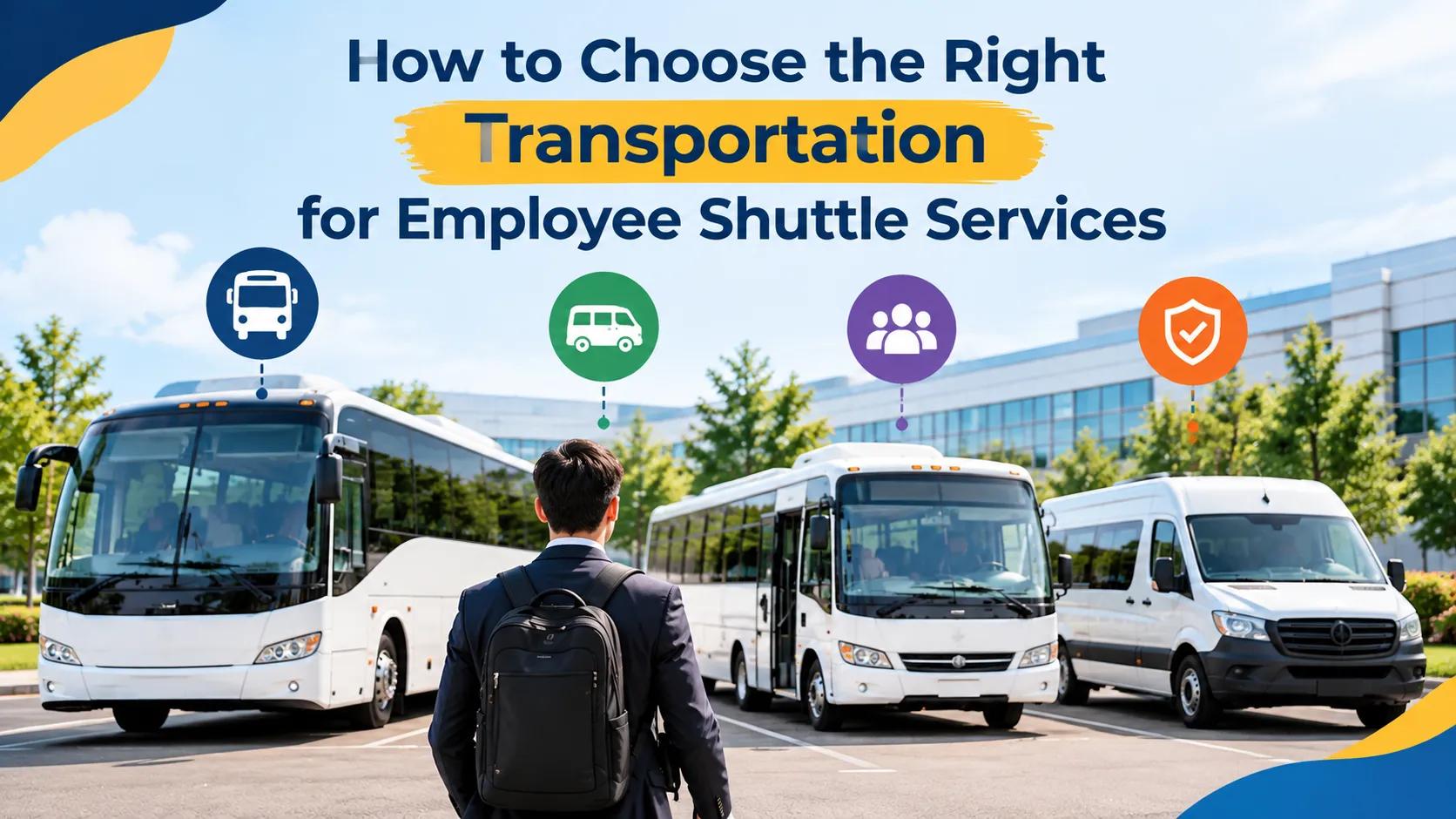
How to Choose the Right Transportation for Employee
Choosing transportation for an employee shuttle program requires more than selecting a vehicle with enough seats. Businesses need to consider employee demand, commuting patterns, work schedules, route distances, accessibility, comfort, and operating requirements before deciding what type of transportation will work best. A carefully planned service can provide employees with a dependable way to travel between convenient pickup locations and their workplace. Understanding different employee transportation options can help businesses create a shuttle program that fits their workforce and daily operations. Companies can also review this employee transportation options guide when evaluating the requirements of a recurring employee transportation program.

Start With Your Employee Transportation Needs
The first step in choosing the right transportation is understanding what employees actually need. A company with a small office workforce may have very different requirements from a manufacturing facility, warehouse, hospital, or corporate campus with hundreds of employees.
Consider where employees are traveling from, how many people may use the shuttle, and what times transportation is needed. Companies should also determine whether employees need transportation from transit stations, parking areas, residential districts, or other centralized locations.
Understanding these requirements helps businesses avoid selecting transportation based only on the number of employees working at the company. The actual number of shuttle riders may be much lower or higher depending on work schedules and commuting patterns.
Compare Vehicle Sizes
Vehicle capacity is one of the most important considerations when planning an employee shuttle. A vehicle should have enough seating for expected riders during the busiest trips without being unnecessarily oversized for the majority of the service.
Smaller shuttle buses can be suitable for companies with limited ridership or shorter routes. Larger charter buses may be more appropriate when many employees travel along the same route or when the service covers longer distances.
Businesses should focus on peak demand when estimating capacity. If a particular departure consistently carries more employees than other trips, selecting a vehicle based only on average ridership could result in insufficient seating.
Consider the Length of the Route
The distance employees need to travel can influence which transportation option makes sense. Short local routes may require a different vehicle configuration from longer commuter routes.
For short trips between a parking facility and workplace, a smaller shuttle may provide an efficient solution. For longer employee commutes, a larger coach with comfortable seating and additional amenities may provide a more suitable experience.
Travel time should also be considered alongside distance. A route covering a relatively short geographic distance can still take considerable time during peak traffic. Businesses should evaluate actual expected travel conditions rather than relying only on mileage.
Match Transportation to Employee Schedules
Work schedules should play a central role in transportation planning. Businesses operating traditional office hours may only need morning and evening shuttle service, while companies with multiple shifts may need transportation throughout the day.
Manufacturing facilities, distribution centers, healthcare organizations, and other businesses operating extended hours may require several departures to accommodate different employee groups.
When selecting transportation, consider how long each trip will take, how much time employees need to board, and how the schedule will coordinate with shift start and end times. A vehicle that works well for one shift may not be appropriate for another if demand or timing changes significantly.
Evaluate Route Flexibility
Some businesses need fixed routes that operate at the same times every weekday. Others may need transportation that can change according to staffing levels, temporary projects, seasonal demand, or different work schedules.
A fixed-route shuttle can provide predictability for employees who use the service regularly. Employees know where to wait and when the bus is expected to arrive.
Businesses with changing transportation needs may require a more flexible arrangement. When discussing options with a transportation provider, companies should explain how often routes or schedules may need to change and ask how those adjustments can be handled.
Consider Employee Comfort
Employee transportation is part of the daily work experience, particularly when workers spend a significant amount of time commuting. Vehicle comfort can therefore influence whether employees consistently use the service.
For longer routes, features such as comfortable seating, climate control, onboard restrooms, Wi-Fi availability, and sufficient storage may be valuable depending on the vehicle and provider.
For shorter shuttle trips, employees may prioritize reliable departure times and convenient pickup locations over additional amenities. Businesses should match vehicle features to the actual length and purpose of the commute rather than paying for features that employees are unlikely to use.
Review Accessibility Requirements
Accessibility should be considered before selecting a vehicle. Businesses should identify whether employees may require wheelchair-accessible transportation or other mobility accommodations.
The transportation provider should receive this information during the planning stage so an appropriate vehicle can be assigned. Pickup locations should also be evaluated to make sure employees can safely reach and board the vehicle.
Planning accessibility requirements in advance can make the service more dependable and reduce the possibility of last-minute transportation changes.
Consider Parking and Pickup Conditions
The physical environment at pickup and drop-off locations can affect which vehicles are practical. Larger charter buses require adequate space to approach, stop, load passengers, and safely depart.
Businesses should evaluate whether proposed locations can accommodate the selected vehicle. Traffic patterns, parking restrictions, construction, road width, and pedestrian activity can all affect how easily a bus can operate at a particular stop.
In some cases, a slightly more distant pickup location may be more practical than a location directly outside the workplace if the latter cannot safely accommodate a large vehicle.
Review Safety and Operational Standards
Employee transportation involves regular travel, so businesses should carefully evaluate the transportation provider's operating practices. Companies should ask about driver qualifications, vehicle maintenance, insurance, inspections, and procedures for handling unexpected transportation problems.
A professional provider should be able to explain how vehicles are maintained and how drivers are assigned to recurring routes. Businesses should also understand how the provider handles vehicle breakdowns, traffic disruptions, severe weather, or other circumstances that could affect service.
Compare the Overall Cost
Transportation costs can vary depending on vehicle type, route length, service frequency, operating hours, number of vehicles, and contract duration. Businesses should look at the overall cost of operating the proposed service rather than focusing only on the hourly or trip rate.
When requesting quotes, provide detailed information about the number of employees, pickup locations, workplace address, operating days, shift schedules, estimated mileage, and expected service frequency.
It is also important to ask whether expenses such as tolls, parking, additional hours, driver overtime, and route changes are included. Understanding these details can make the transportation budget easier to manage.
Monitor the Service After Launch
Choosing the right transportation does not have to be a permanent decision. Businesses should monitor the service after it begins and compare actual usage with initial expectations.
Ridership data can reveal whether certain routes are consistently full or underused. Employee feedback can identify issues with pickup locations, schedules, travel times, or vehicle comfort.
If demand increases, the company may need additional capacity or another departure. If demand decreases, routes and schedules may be adjusted to improve efficiency.
Create an Employee Shuttle That Fits Your Business
The right employee shuttle transportation depends on the specific needs of the business and its workforce. Vehicle capacity, route distance, employee schedules, accessibility, comfort, pickup conditions, safety requirements, flexibility, and cost all need to be considered before making a decision.
Rather than selecting a vehicle based solely on size or price, businesses should evaluate how the transportation option will perform throughout the entire workday. A properly planned shuttle can connect employees with their workplace, support multiple shifts, reduce transportation challenges, and provide a more predictable commuting option.
By gathering accurate employee demand information and working with a professional transportation provider, businesses can create an employee shuttle service that is practical today and flexible enough to adapt as workforce requirements change.