

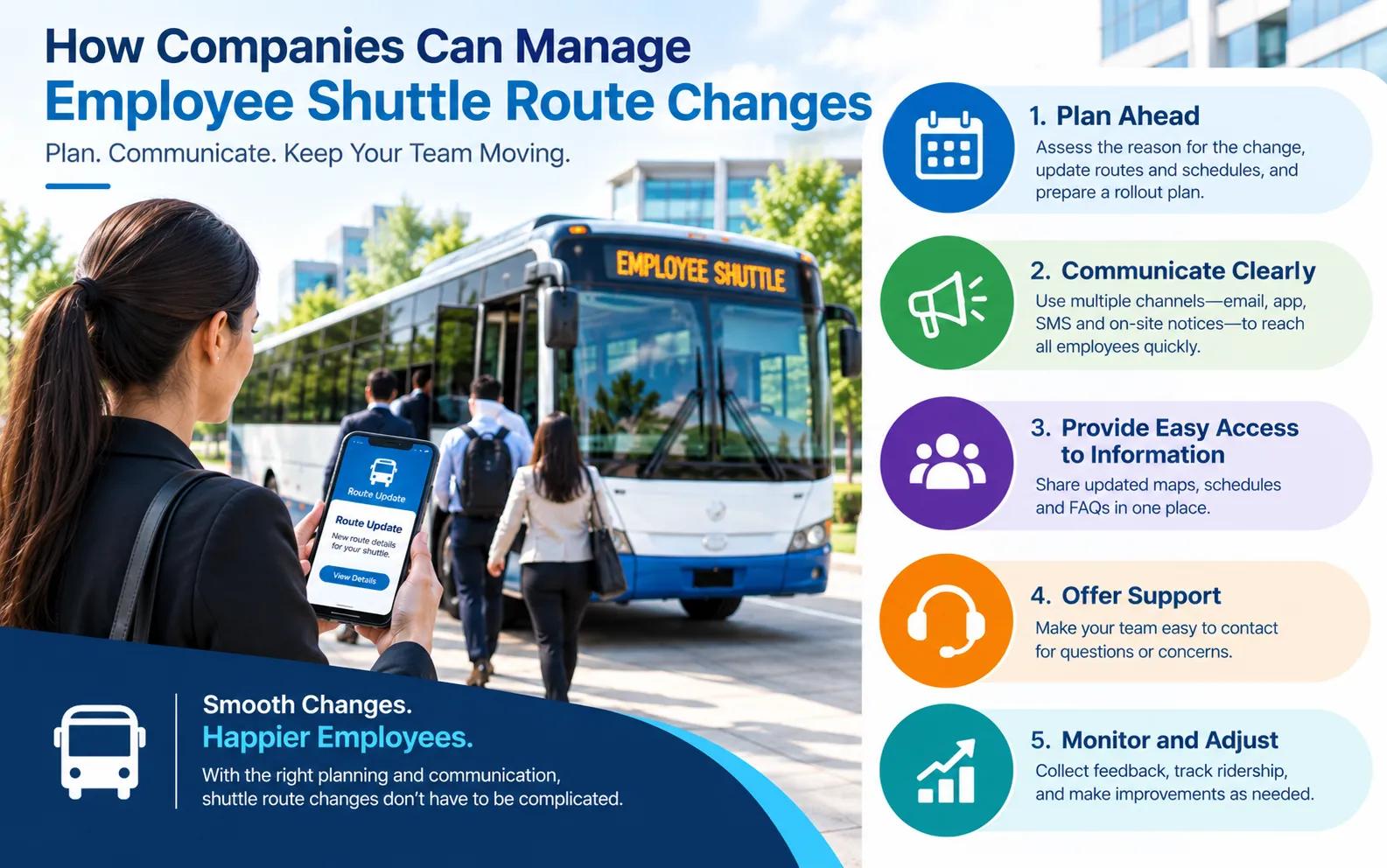
How Companies Can Manage Employee Shuttle Route Changes
Employee shuttle programs can make commuting more convenient for workers, but routes rarely remain unchanged forever. Office relocations, construction, changing work schedules, traffic conditions, parking restrictions, and shifts in employee demand can all require transportation adjustments. Managing these changes effectively requires more than modifying a route on a schedule. Companies also need a clear process for communicating updates, preparing employees, and monitoring the transition. A strong employee shuttle route management strategy can help businesses reduce confusion and maintain reliable transportation. Companies can also use this guide to manage shuttle route updates when preparing employees for upcoming changes.

Understand Why the Route Needs to Change
The first step in managing an employee shuttle route change is understanding why the adjustment is necessary. Transportation teams may identify a need for change because a pickup location is no longer available, a workplace has moved, employee demand has increased, or a route is no longer practical for current commuting patterns.
Understanding the reason helps transportation coordinators determine how significant the change will be. A temporary construction detour may require a different communication approach from permanently removing a pickup stop. Similarly, adjusting a departure time by a few minutes may have a much smaller impact than changing an entire route.
Defining the reason and scope of the change allows companies to plan the transition more effectively.
Identify Employees Affected by the Change
Before announcing a route adjustment, companies should determine exactly which employees will be affected. A change to one pickup location may only affect a particular group of riders, while a larger route modification could impact employees across several departments or shifts.
Existing shuttle registration information can help transportation coordinators identify riders connected to the affected route. Companies should also consider employees who may be scheduled to begin using the route after the change takes effect.
Identifying affected employees early helps ensure that important information reaches the right people. It also prevents unnecessary announcements from creating confusion among employees whose transportation arrangements are not changing.
Determine the Impact on Daily Commutes
Not every route change affects employees in the same way. Moving a pickup stop may increase walking distance, while changing departure times can affect employees' morning routines or shift schedules.
Transportation coordinators should consider how the change will affect travel before finalizing the new arrangement. Reviewing pickup locations, expected travel times, traffic patterns, and employee work schedules can provide useful context.
This planning stage can also reveal potential problems before employees experience them. If a proposed stop creates an unusually long walking route or conflicts with a major shift change, the transportation team may be able to address the issue before implementation.
Choose an Appropriate Timeline
The amount of preparation time should reflect the size of the route change. A minor adjustment may be easier to implement quickly, while a major change can require several weeks of preparation.
Companies should provide employees with enough notice to adjust their routines whenever circumstances allow. Employees may need to identify a new pickup location, change the time they leave home, or coordinate other personal responsibilities around a revised shuttle schedule.
Unexpected situations can make advance notice difficult. Road closures, emergency repairs, severe weather, or sudden facility restrictions may require immediate route changes. In these cases, companies should communicate the available information as quickly as possible and provide additional updates as details become available.
Communicate the Change Clearly
Once the new route has been confirmed, employees should receive a straightforward announcement. The message should explain what is changing, when the change becomes effective, and what employees need to do differently.
If a pickup location is moving, the announcement should provide the new location and useful directions. If the departure time is changing, the new schedule should be clearly stated. Employees should also know whether the change is temporary or permanent.
A short explanation of why the route is changing can provide helpful context. However, practical information should remain the focus of the announcement so employees can quickly understand how their commute will be affected.
Use Several Communication Channels
Companies should avoid relying entirely on a single email when communicating significant transportation changes. Employees may miss emails, work different shifts, or not regularly check workplace communications.
Route updates can be reinforced through internal messaging platforms, employee apps, company intranets, digital notices, and physical signs at affected pickup locations. Managers can also remind employees during team meetings or shift briefings.
The information should remain consistent across every channel. Employees should receive the same effective date, pickup location, and schedule regardless of where they find the announcement.
Update All Shuttle Information
Changing the route itself is only one part of the process. Companies should also update every resource that contains transportation information.
This may include digital schedules, route maps, employee transportation portals, reservation systems, onboarding materials, and shuttle tracking applications. If the company uses GPS-based tracking, the updated stop location should be reflected there before employees begin using the new route.
Physical signs can also be important. If a pickup stop has moved, a temporary notice at the old location can direct employees toward the new stop. This can help riders who missed the original announcement or simply follow their old routine out of habit.
Consider Accessibility and Employee Needs
Route changes can affect employees differently depending on their individual transportation needs. A new stop may have a longer walking distance, different access points, or other characteristics that create challenges for some riders.
Companies should consider accessibility when evaluating proposed route changes. Employees with documented transportation accommodations may require direct communication if their ability to access the shuttle could be affected.
Providing clear directions and suitable signage can also make a new stop easier for all employees to use. Accessibility should be part of the planning process rather than something considered only after the route changes.
Prepare for the Transition Period
The first few days after a route change may require additional attention. Employees who have used the same stop for months may instinctively return to the old location even if they received the announcement.
Companies can reduce this problem by placing temporary signs at the previous stop and providing clear directions to the new location. For major changes, a transportation coordinator or designated representative can be available near the affected stop during the first morning.
Drivers can also remind regular riders about the updated route. These simple measures can help employees become comfortable with the new arrangement more quickly.
Monitor the New Route
After the change takes effect, transportation teams should monitor how the new route performs. Employee feedback can provide useful information about whether the new schedule and pickup locations are working as expected.
Companies can pay attention to ridership levels, recurring questions, missed pickups, and employee comments during the first few weeks. If several riders report the same issue, transportation coordinators can determine whether additional communication or an operational adjustment is necessary.
Monitoring also helps companies identify whether the original reason for the route change has been addressed.
Keep a Record for Future Planning
Maintaining a record of route changes can make future transportation decisions easier. Companies can document the reason for the adjustment, affected routes, effective dates, communication methods, employee feedback, and any problems encountered during implementation.
Over time, these records can reveal recurring transportation patterns. They can also provide useful guidance to new transportation coordinators who take responsibility for the shuttle program.
A simple change log does not need to be complicated. Even basic records can help companies understand what worked well and where future improvements may be needed.
Create a Repeatable Route Change Process
Employee shuttle route changes are easier to manage when companies use a consistent process rather than handling every adjustment differently. Transportation teams can establish procedures for reviewing proposed changes, identifying affected employees, communicating updates, updating shuttle information, and monitoring the transition.
A repeatable process reduces the possibility of missed details and makes it easier to coordinate transportation changes across multiple routes or employee groups.
Conclusion
Managing employee shuttle route changes requires coordination between transportation teams, employees, managers, and other workplace stakeholders. Companies need to understand why a change is necessary, identify affected riders, provide sufficient notice, communicate accurate information, update transportation resources, and monitor the results.
When route changes are handled as part of a structured employee shuttle management process, companies can make transportation adjustments easier for employees to understand and easier for transportation teams to implement. Clear communication and thoughtful planning can support a more dependable workplace shuttle program even when routes and schedules need to change.