

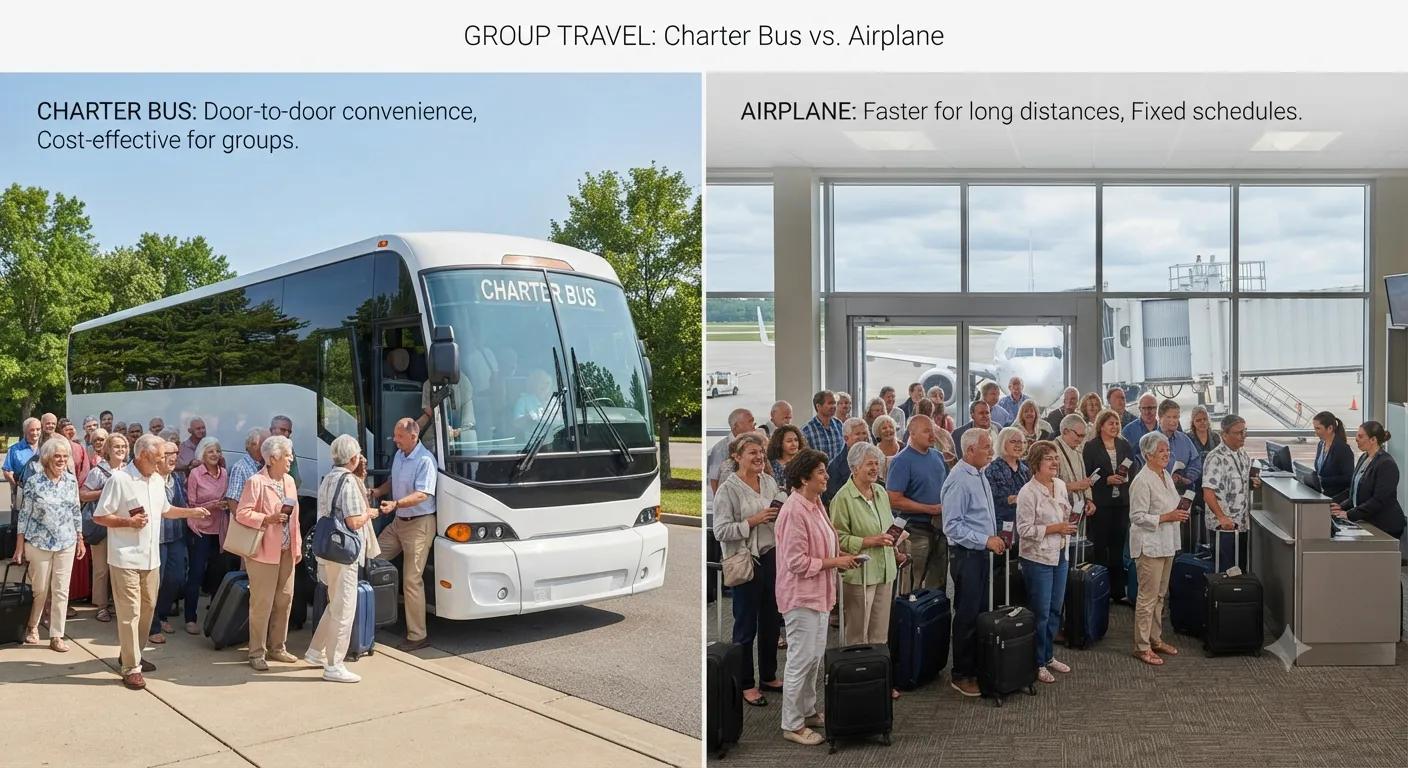
Flying or Taking a Charter Bus? A Guide for Large Groups
When a large group needs to travel, choosing the right transportation can have a major impact on the entire trip. Airplanes offer speed, while charter buses provide flexibility, group convenience, and direct transportation. The better option depends on factors such as distance, budget, number of travelers, luggage, and the overall itinerary. For a closer look at the differences, this group travel transportation comparison can help travelers understand what to consider before making a decision.
For families, corporate teams, school groups, sports organizations, wedding parties, and tour groups, transportation planning becomes more complicated as the number of passengers increases. Comparing both options carefully can help organizers avoid unnecessary expenses and logistical problems.

Flying for Large Groups
Air travel is often the first option people consider when they need to cover a long distance quickly. Airplanes can cross hundreds or thousands of miles in a relatively short amount of time, making them useful for long-distance and international journeys.
However, the actual travel process involves more than flight time. Travelers may need to arrange transportation to the airport, arrive early for check-in and security, wait for boarding, collect luggage after landing, and then find transportation to the final destination.
For a large group, coordinating all these steps can require considerable planning.
Taking a Charter Bus
A charter bus provides a different approach to group transportation. Instead of having everyone arrange individual tickets and airport transportation, the group can travel together in one vehicle.
Depending on the selected coach, passengers may have access to reclining seats, climate control, overhead storage, luggage compartments, Wi-Fi, power outlets, and an onboard restroom.
The biggest advantage is that the group remains together throughout the journey. This makes it easier for organizers to manage schedules and communicate with passengers.
Comparing the Overall Cost
The cost of flying can vary considerably depending on the destination, travel date, airline, and booking time. Large groups also need to account for additional expenses such as checked baggage, airport parking, ground transportation, and potentially different ticket prices for different travelers.
With a charter bus, the group typically rents the entire vehicle. The cost can then be shared among passengers.
This approach can be particularly attractive for larger groups traveling moderate distances. Instead of paying for dozens of individual tickets, everyone contributes toward one transportation service.
Convenience and Door-to-Door Travel
One of the strongest advantages of charter bus transportation is convenience.
An airplane takes travelers from one airport to another, but the trip does not necessarily end at the arrival airport. A group may still need to arrange taxis, rideshares, rental cars, or another shuttle service.
A charter bus can often pick up passengers from a designated location and take them directly to their destination. This can reduce the number of separate transportation arrangements needed.
For event organizers, having one vehicle and one transportation schedule can make the entire itinerary easier to manage.
Keeping the Group Together
Large groups can become difficult to coordinate when traveling by plane. Depending on availability, travelers may be spread across multiple flights or seating sections.
A charter bus keeps the group together in one place. Everyone leaves from the same pickup location and generally follows the same route.
This is especially helpful for school trips, corporate events, sports tournaments, weddings, family reunions, and organized tours.
Luggage and Equipment Considerations
Luggage is another important factor when comparing transportation options.
Airlines have specific baggage rules, and additional bags or oversized equipment may result in extra charges. This can become a concern for sports teams, performers, event groups, and travelers carrying substantial equipment.
Charter buses typically have dedicated storage areas for luggage. Groups can often load suitcases and equipment underneath the passenger cabin, leaving more room inside for travelers.
Before reserving a bus, organizers should confirm the vehicle's storage capacity based on the number of passengers and amount of equipment.
Flexibility in Scheduling
Airlines operate according to fixed departure and arrival schedules. Groups have to build their itinerary around available flights.
Charter buses generally provide more flexibility. Groups can arrange pickup times according to their schedule and may be able to include additional stops along the route.
This can be especially useful for multi-stop trips where travelers need transportation between hotels, attractions, venues, campuses, stadiums, or event locations.
Comfort on the Road
Long-distance bus travel does not have to mean sacrificing comfort. Modern motorcoaches can include features designed for extended journeys.
Passengers may be able to recline their seats, use onboard Wi-Fi, charge devices, access climate controls, and store personal belongings. Some coaches also have restrooms, reducing the need for frequent stops.
Travelers can also socialize with their group instead of sitting separately in different vehicles.
When Flying Is the Better Choice
Flying is usually the stronger choice when distance is the primary concern. If a group needs to travel across the country or internationally and has limited time, the speed of air travel can be extremely valuable.
It can also make sense when the group is relatively small or when the destination is poorly suited to a long road journey.
The key is to consider the complete itinerary and not just the time spent in the air.
When a Charter Bus May Be Better
A charter bus can be an excellent option for larger groups traveling moderate distances. The advantages become even more noticeable when everyone is traveling to the same destination.
Groups can avoid coordinating multiple vehicles and may benefit from shared transportation costs. The ability to customize pickup times and stops can also make charter buses useful for trips with complex schedules.
Schools, companies, sports teams, wedding parties, churches, families, and tour operators can all benefit from this type of group transportation.
Safety and Group Planning
Safety should always be considered when choosing transportation. Both commercial aviation and professional motorcoach transportation operate under safety requirements, but travelers should still research their chosen provider.
Before booking a charter bus, organizers should review the company's credentials, driver qualifications, insurance information, and maintenance practices.
Good planning also contributes to a safer and smoother trip. Sharing pickup instructions, passenger information, emergency contacts, and itinerary details with everyone can help prevent confusion.
How to Make the Right Decision
There is no single transportation option that works for every large group. Instead, organizers should compare several factors:
Consider the Distance
Shorter and moderate-distance journeys may favor charter bus transportation, while extremely long journeys may favor flying.
Calculate the Complete Cost
Look beyond the basic airfare. Include baggage, airport transfers, parking, rental vehicles, and other transportation expenses.
Think About the Itinerary
If the trip includes multiple stops, a charter bus can provide greater flexibility.
Consider Group Size
The larger the group, the more valuable it can be to have one dedicated vehicle rather than coordinating dozens of individual travel arrangements.
Final Thoughts
Flying and charter bus travel each have advantages. Airplanes provide speed and are often the most practical choice for very long-distance journeys. Charter buses, meanwhile, offer flexibility, direct transportation, group cohesion, and potentially lower per-person costs for larger groups.
The best choice depends on your destination, travel distance, passenger count, budget, luggage requirements, and schedule. By comparing the complete journey rather than focusing on one part of the trip, organizers can choose transportation that provides the right combination of value and convenience.