

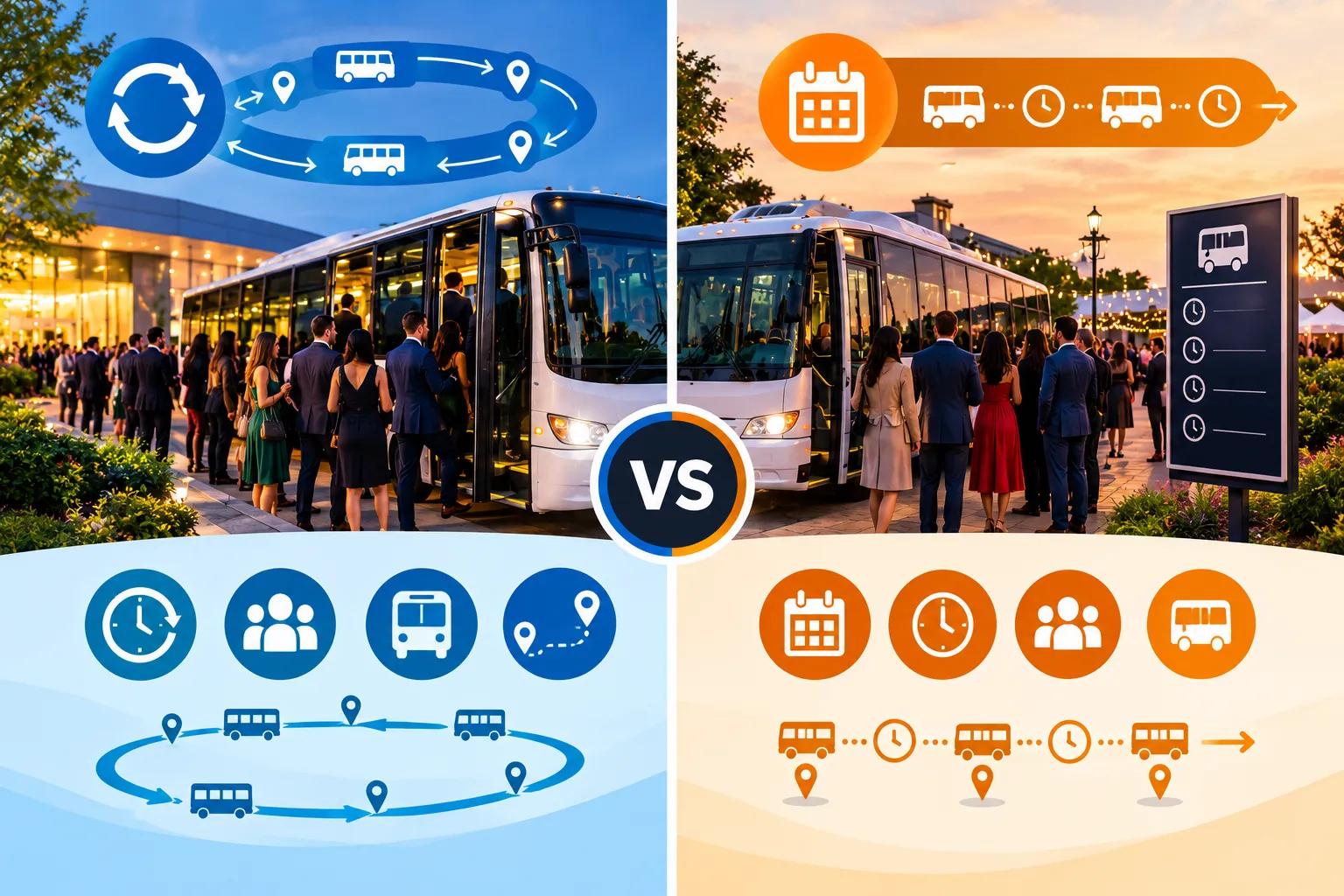
Event Transportation Guide: Continuous Loop vs. Scheduled
Planning transportation for an event involves more than choosing the right vehicles. Organizers also need to decide how those vehicles will operate throughout the day. Two of the most common approaches are continuous loop service and scheduled shuttle service. Understanding the difference can help planners create a smoother experience for guests while controlling unnecessary delays and transportation costs. For a closer look at how these models compare, this guide to event shuttle planning provides useful information for building an effective event transportation strategy.

Understanding Continuous Loop Shuttle Service
A continuous loop shuttle operates throughout a defined service window. Instead of assigning guests to specific departure times, buses repeatedly travel between designated stops. Guests arrive at a shuttle stop, wait for the next available vehicle, and continue to their destination.
This approach works particularly well when guest arrivals and departures are spread throughout several hours. Conferences, festivals, campus events, conventions, trade shows, and large gatherings can benefit from this type of transportation because attendees may not all travel at the same time.
The main advantage is flexibility. Guests do not need to memorize several departure times or worry about missing a particular bus. Instead, they know that another shuttle should arrive after a relatively short interval.
However, the number of buses and the length of the route are important considerations. Longer routes can create longer intervals between vehicles, while poorly coordinated buses can become bunched together and leave passengers waiting for the next group of vehicles.
What Is Scheduled Shuttle Service?
Scheduled shuttle service operates according to predetermined departure times. Instead of telling guests that a bus will arrive approximately every ten or fifteen minutes, the organizer provides specific departure times.
For example, a wedding transportation plan might have buses leaving hotels at 3:30 p.m., 3:50 p.m., and 4:10 p.m. Guests can select or be assigned a departure and arrive at the designated pickup point before that time.
Scheduled service is especially useful when an event has a fixed agenda. Weddings, conferences with strict opening sessions, corporate meetings, sports competitions, concerts, and ceremonies often have specific start times that make transportation timing especially important.
The primary benefit is predictability. Guests know when they need to be ready, and transportation planners can coordinate vehicle movements around important event milestones.
Choosing the Right Model for Your Event
The best transportation model depends heavily on how guests move throughout the event. A continuous loop generally makes sense when people arrive and leave at different times. If attendees are continuously entering a venue, visiting different locations, or leaving throughout the day, a loop can provide convenient access without requiring everyone to follow the same timetable.
Scheduled shuttle service becomes more practical when transportation demand occurs in predictable waves. If hundreds of guests need to arrive before a keynote presentation, wedding ceremony, game, or performance, scheduled departures can organize those passengers around the event's timeline.
Route length is another important factor. Short routes can support frequent continuous service because buses can complete their circuits relatively quickly. On longer routes, a small fleet may produce lengthy gaps between buses. A scheduled system can sometimes provide a more practical solution because guests know exactly when transportation is available.
Guest Experience Should Be a Priority
Transportation is often one of the first and last impressions guests have of an event. Confusing shuttle information can create unnecessary stress, especially for people unfamiliar with the venue or surrounding area.
With continuous service, communication should focus on the service window and expected frequency. Guests should know where the stops are located, when service begins, how frequently buses generally arrive, and when the final shuttle will operate.
Scheduled service requires more detailed communication. Organizers should clearly provide departure times, pickup locations, recommended arrival times, and information about what happens if someone misses a scheduled departure.
Clear signage can also make a major difference. Shuttle stops should be easy to identify, and event staff should be available to answer questions when large groups are traveling.
Considering Event Size and Passenger Demand
Passenger volume can influence which transportation strategy works best. A large event with steady passenger movement may benefit from several buses circulating continuously. This allows passengers to board without creating large crowds around individual departure times.
A smaller event with a defined guest list may benefit from scheduled departures. Rather than operating vehicles continuously when passenger demand is low, organizers can coordinate a few well-timed trips.
Peak demand also deserves careful attention. Even a continuous loop can become overcrowded immediately before an event begins. Similarly, a scheduled service may experience heavy demand for one particular departure. Event planners should review expected attendance and identify periods when additional vehicles may be necessary.
Hybrid Shuttle Service Can Offer Greater Flexibility
Event planners do not always have to choose only one model. A hybrid transportation strategy can combine continuous and scheduled service based on different parts of the event.
For example, a conference may use scheduled departures during the morning when attendees are traveling toward the venue for opening sessions. Once the main sessions begin, a continuous loop could operate between hotels, parking areas, and the convention center.
A wedding could also use scheduled transportation before the ceremony and provide more flexible return service after the reception. This approach allows transportation to match the changing movement patterns of guests throughout the day.
Hybrid planning can be especially useful for multi-day conferences, festivals, campus events, sports tournaments, and corporate gatherings where passenger demand changes significantly from one period to another.
Planning Around Accessibility Needs
Accessibility should be considered regardless of the shuttle model selected. Guests who use mobility devices or require additional boarding assistance may need specific transportation arrangements.
With continuous service, planners should make sure accessible vehicles are available frequently enough to avoid unnecessary waiting. With scheduled service, accessible transportation can be coordinated around specific departures, but guests need clear information about where and when to board.
Discussing accessibility requirements with the transportation provider before the event allows the operator to plan appropriate vehicles and boarding procedures in advance.
Managing Traffic and Unexpected Delays
Traffic conditions can affect both transportation models differently. Continuous loops can provide some flexibility because a delayed bus simply increases the expected wait for passengers. Scheduled service requires more careful timing because delays can interfere with published departure commitments.
Event planners should account for traffic patterns, loading times, venue restrictions, parking conditions, and potential congestion when creating the transportation plan. Building realistic travel times into the schedule can reduce last-minute problems.
A transportation coordinator or dispatcher can also help monitor vehicles during the event and communicate changes to drivers and event staff.
Making the Final Transportation Decision
Before selecting a shuttle model, event organizers should consider the guest arrival pattern, departure pattern, route length, number of stops, event schedule, expected passenger volume, accessibility requirements, and available fleet.
The goal is not simply to choose the cheapest transportation structure. The right system should provide dependable service without creating excessive waiting, confusion, overcrowding, or unnecessary vehicle use.
Continuous loop service is generally strongest when flexibility and frequent movement are priorities. Scheduled shuttle service is more suitable when guests need to reach a destination at specific times. In many situations, combining both approaches can provide the most efficient overall solution.
Conclusion
Choosing between continuous loop and scheduled shuttle service is an important part of successful event transportation planning. Each model has different strengths, and the right option depends on how guests arrive, where they need to travel, how long the routes are, and when transportation demand reaches its peak.
A continuous loop can provide flexibility for events with steady or unpredictable passenger movement, while scheduled departures offer greater predictability for events built around fixed start times. For complex gatherings, a hybrid model can combine the benefits of both.
By evaluating passenger demand, route conditions, event timing, accessibility needs, and communication requirements in advance, organizers can create a transportation plan that keeps guests moving comfortably and efficiently from arrival through the final departure.