

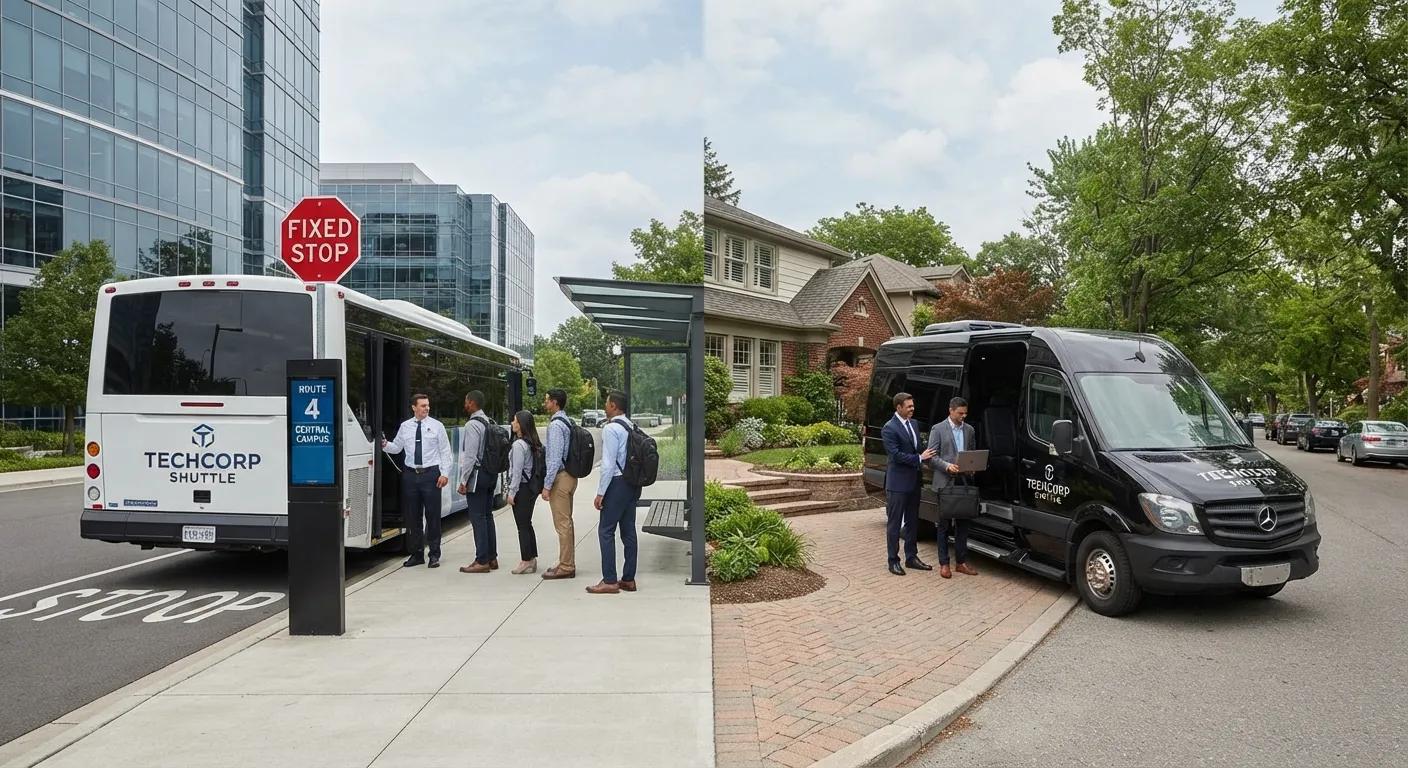
Employee Shuttle Transportation
Reliable transportation can have a direct impact on employee punctuality, commuting stress, attendance, and workplace satisfaction. For companies operating large offices, campuses, warehouses, manufacturing facilities, or remote worksites, an employee shuttle can provide a practical alternative to driving alone. However, choosing the right route structure is just as important as choosing the right vehicle. A well-designed employee commuter transportation program should balance convenience, travel time, capacity, safety, and operating efficiency.

Two common approaches are fixed pickup stops and door-to-door service. While both can help employees reach work, they create very different experiences for riders and transportation managers. Understanding how each model works can help businesses choose a system that supports their workforce without creating unnecessarily long routes.
What Is a Fixed-Stop Employee Shuttle?
A fixed-stop shuttle operates according to predetermined pickup locations and scheduled departure times. Employees travel to these designated locations and board the vehicle before continuing to the workplace.
Common fixed-stop locations include transit stations, park-and-ride facilities, commercial parking areas, residential hubs, and other convenient gathering points. The objective is to place stops where enough employees can reasonably reach them while allowing the shuttle to maintain an efficient route.
This approach offers predictability. Employees know where they need to be, drivers have a defined route, and transportation managers can estimate travel times more accurately. Fixed routes can also make it easier to manage vehicle capacity because expected ridership can be associated with each stop.
What Is Door-to-Door Employee Transportation?
Door-to-door employee shuttle service provides a more personalized approach. Instead of requiring workers to travel to a centralized pickup point, the shuttle operates closer to individual homes or specific residential locations.
This can be particularly useful for employees who live in areas with limited public transportation or who may have difficulty reaching a fixed stop. It can also make a company transportation program more attractive to employees who would otherwise drive themselves.
However, door-to-door service can become complicated as the number of riders increases. Residential streets may have traffic restrictions, limited parking, narrow roads, construction, or other conditions that make frequent bus stops difficult. Each additional pickup can also increase the overall journey time.
Comparing Convenience With Efficiency
The primary difference between the two models is the balance between individual convenience and overall efficiency.
Fixed stops may require employees to walk, drive, or use public transportation for part of their commute before reaching the shuttle. Once they board, however, the vehicle can generally follow a more direct route with fewer interruptions.
Door-to-door transportation reduces the distance employees need to travel before boarding, but the shuttle itself may take longer to reach the workplace. Employees who board first may remain on the vehicle while numerous additional passengers are collected.
For a large workforce spread across a metropolitan area, fixed pickup locations can therefore be easier to manage. A smaller workforce concentrated within several nearby neighborhoods may have more flexibility for a personalized route.
Employee Geography Should Shape the Route
The location of employees should be one of the first factors considered when designing a shuttle.
If many employees live within the same neighborhood or along the same transit corridor, a centralized pickup point can serve a significant number of riders efficiently. If employees are scattered across a wide geographic area, a single fixed-stop route may leave too many workers without convenient access.
Companies can review general information such as ZIP codes, neighborhoods, major intersections, and transit connections to identify rider clusters. This information can help transportation planners determine whether employees are better served by a few centralized stops or a more flexible service.
Charter Buses USA recommends considering employee demand, work locations, shift schedules, parking constraints, transit connections, and vehicle requirements when developing workforce transportation programs.
Route Time Matters for Every Passenger
A shuttle should make commuting easier, but excessive route time can undermine that goal.
Every additional stop requires time for the vehicle to approach the location, allow passengers to board, and safely re-enter traffic. Although one extra stop may seem insignificant, several additional stops can substantially increase the total journey.
For example, a pickup that adds only five minutes may seem reasonable when viewed independently. If a route has six additional stops, however, the cumulative delay can become significant. Employees who are already on the bus may eventually spend more time commuting than they would have spent driving themselves.
Transportation planners should therefore evaluate each proposed stop based on how many employees it serves and how much time it adds to the complete route.
Safety and Accessibility Are Essential
A pickup location should be convenient, but convenience should never be the only consideration. Employees may use the shuttle during early mornings, late evenings, winter weather, or periods of heavy traffic.
A suitable stop should provide a safe waiting area and allow the vehicle to approach, load passengers, and leave without creating unnecessary traffic hazards. Pedestrian access, lighting, road conditions, property permission, and vehicle clearance should all be considered before a location is finalized.
Accessibility should also be incorporated into route planning. If an employee requires accessible transportation, both the vehicle and pickup environment need to support safe boarding. A location that looks convenient on a map may not provide an appropriate accessible path.
The Role of Shift Schedules
Employee shuttle routes should be designed around actual work schedules rather than a generic morning and evening commute.
Manufacturing facilities, hospitals, warehouses, call centers, distribution centers, and other businesses may operate multiple shifts throughout the day. An efficient route for a daytime workforce may not work for employees arriving before sunrise or leaving late at night.
Shift schedules can influence the number of vehicles required, pickup times, route direction, and even the suitability of certain stops. A location that is convenient during daylight may be less appropriate for an overnight shift.
Building the transportation schedule around clock-in requirements can help employees arrive with enough time to enter the workplace and prepare for their shifts.
A Hybrid Approach Can Provide More Flexibility
Businesses do not always have to choose between completely fixed stops and fully door-to-door service.
A hybrid employee shuttle program can combine centralized pickup points with more flexible transportation for selected areas. For example, a company could use fixed stops along major commuting corridors while providing closer pickup options for employees in areas with significant demand.
Another possibility is using fixed routes during peak periods and a smaller, more flexible vehicle for employees working unusual shifts. This can provide additional coverage without requiring every regular route to include numerous residential stops.
A hybrid model can be especially useful when employee demand varies considerably throughout the week.
Choosing the Right Employee Shuttle Model
The right transportation model depends on the workforce, route geography, operating schedule, and business objectives.
Fixed pickup stops are generally well suited to companies that prioritize predictable schedules, efficient routes, and transportation for larger groups. They can work particularly well when employees are concentrated around transit hubs, parking facilities, or major residential areas.
Door-to-door service may be more appropriate when employee convenience is a higher priority and riders live close enough together to keep the route manageable. It can also provide valuable flexibility for employees who cannot easily access centralized stops.
Before choosing a model, employers should evaluate expected ridership, vehicle capacity, route mileage, travel time, traffic patterns, shift schedules, accessibility, and pickup safety.
How to Build a More Effective Shuttle Program
A successful employee transportation program should begin with a clearly defined objective. The company may want to reduce parking demand, connect employees with public transportation, improve access to a remote workplace, or provide reliable transportation for specific shifts.
Once the objective is clear, employee demand can be mapped and potential pickup locations evaluated. Proposed routes should then be tested against realistic traffic conditions and workplace arrival requirements.
After the shuttle launches, companies should continue monitoring ridership and route performance. Employee locations, schedules, traffic patterns, and workforce size can change over time. A route that worked well when the program started may require adjustments as demand changes.
Fixed Stops vs. Door-to-Door: Which Option Is Better?
Neither fixed-stop nor door-to-door transportation is automatically the best choice for every business. Fixed stops generally provide stronger route efficiency and predictable scheduling, while door-to-door service offers greater individual convenience.
For many employers, the most effective solution may combine the two approaches. Centralized stops can handle the majority of riders efficiently, while flexible transportation can address specific geographic or accessibility needs.
The goal of an employee shuttle is not simply to bring a bus as close as possible to every employee. It is to create a reliable transportation option that employees can use consistently without unnecessarily increasing their daily commute. By evaluating employee demand, route time, safety, accessibility, and operational requirements, businesses can develop a shuttle program that works for both their employees and their organization.