

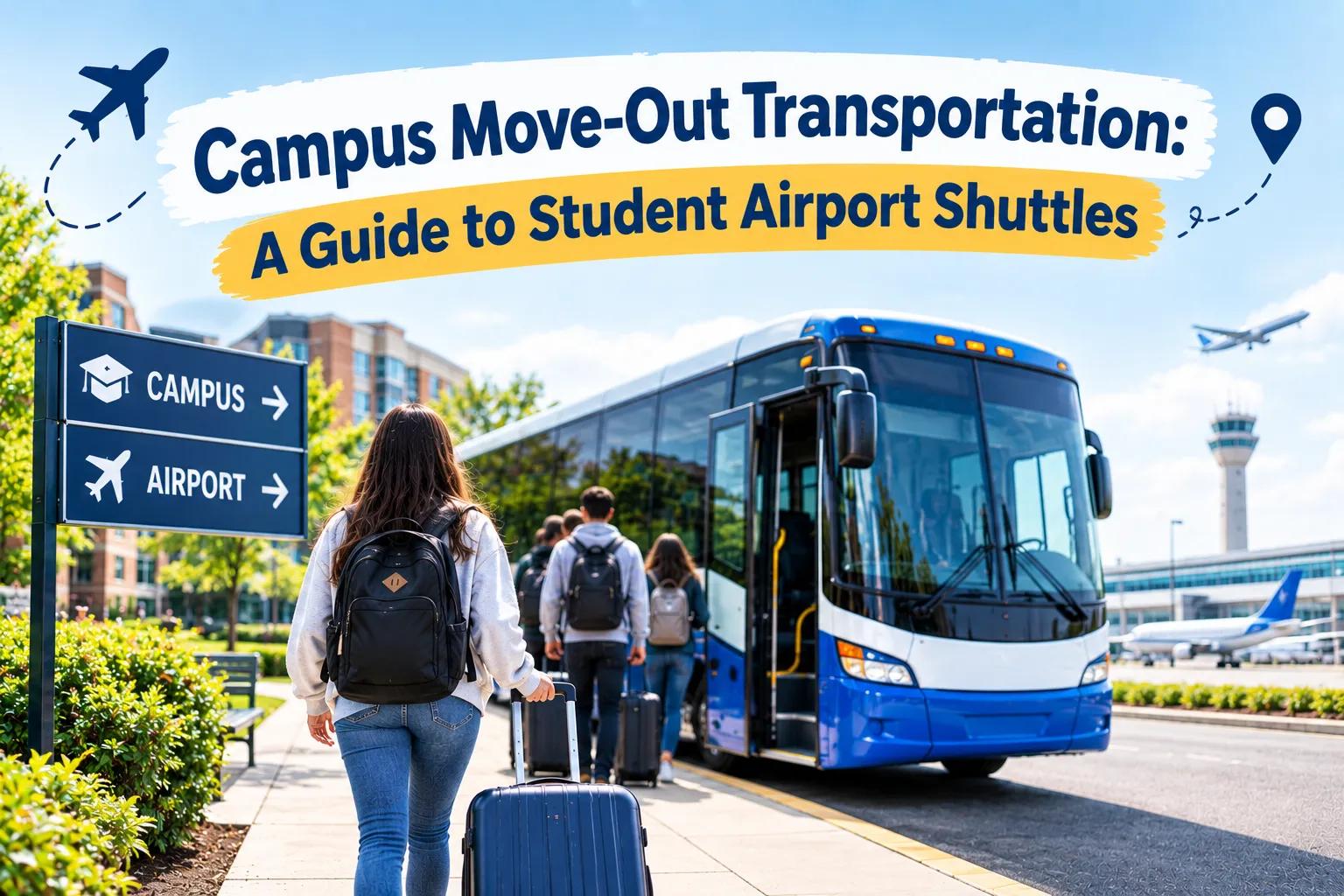
Campus Move-Out Transportation: A Guide to Student
When a college semester comes to an end, students have much more to manage than final exams. They must pack their belongings, complete residence hall checkout, return keys, and arrange transportation for the trip home. For students traveling by air, getting from campus to the airport can be one of the most important parts of the move-out process. Well-planned student airport shuttle transportation can give universities a practical way to organize departures while helping students travel with their luggage more comfortably.

Understanding the Challenges of Campus Move-Out
Campus move-out creates a unique transportation situation because many students leave within a relatively short period. Their departure times, destinations, and flight schedules can vary significantly. One student may need to reach the airport before sunrise, while another may have an evening flight.
The situation can become more complicated when residence halls have fixed checkout deadlines. Students may need to finish an exam, pack their rooms, load their belongings, and reach a shuttle within only a few hours.
Students without personal vehicles may consider rideshare services or public transportation, but carrying multiple suitcases through transfers can be inconvenient. During peak move-out periods, individual transportation options may also experience increased demand.
A dedicated airport shuttle program can give students a scheduled transportation option that is designed around the needs of the campus community.
Start Planning Transportation Early
Successful move-out transportation generally begins well before the final week of the semester. Universities, housing departments, international student offices, and student organizations can review the academic calendar and residence hall closing dates before estimating transportation demand.
Early planning also allows organizers to communicate shuttle availability before students finalize their travel plans. If students know that buses will operate during specific departure windows, they may be able to choose flights that fit those schedules.
Collecting student travel information several weeks in advance can also help organizers identify the busiest departure periods. This information can then be used to determine the number and size of vehicles required.
Group Students According to Flight Times
One of the most effective approaches to campus airport transportation is organizing students into departure groups based on their flight schedules.
Rather than assigning every student to the same bus, transportation coordinators can create multiple departure windows. Students with morning flights can travel on earlier shuttles, while students with afternoon or evening flights can use later departures.
The schedule should be created by working backward from the desired airport arrival time. Planners need to consider the drive between campus and the airport, traffic conditions, luggage loading, and the amount of time students need before their flights.
International travelers may need additional time for airline check-in and document requirements. Students should always follow the specific airport and airline guidance for their flight when determining the appropriate arrival time.
Consider Luggage Capacity Carefully
Luggage is one of the biggest factors that separates campus move-out transportation from ordinary group travel. Students may be taking home an entire semester's worth of belongings, including clothing, books, electronics, personal items, and storage boxes.
A student traveling with two checked bags, a carry-on, and a backpack requires considerably more storage space than someone taking a short weekend trip.
For this reason, transportation planners should evaluate luggage capacity along with passenger capacity. Full-size charter buses often have dedicated under-floor luggage compartments that can accommodate larger quantities of baggage. Smaller vehicles may have less storage space depending on their configuration.
When students register for a shuttle, organizers can ask how many checked bags and carry-on items they expect to bring. Oversized belongings such as bicycles, musical instruments, sports equipment, and large boxes should be communicated to the transportation provider in advance.
Select Convenient Campus Pickup Points
The pickup location can have a significant effect on the student experience. During move-out, students may already be carrying heavy luggage, so a pickup point that requires a long walk across campus can create unnecessary difficulty.
For smaller campuses, a central pickup location near residence halls may be sufficient. Larger universities may need several pickup points to serve different residential areas.
However, too many stops can increase travel time and make airport schedules harder to maintain. Transportation planners should therefore select locations that are convenient for students while still allowing buses to load safely and efficiently.
Pickup areas should also provide enough space for students to wait, organize their luggage, and board without interfering with other campus move-out traffic.
Communicate the Shuttle Schedule Clearly
A transportation plan works best when students understand exactly what is expected of them. Once departure waves have been finalized, organizers should provide each student with their assigned date, departure time, pickup location, luggage requirements, and transportation contact information.
A reminder before travel day can reduce missed departures. Students should be encouraged to arrive at the pickup point before the scheduled departure time rather than arriving at the last moment.
Universities should also explain what happens if a student misses a scheduled shuttle. If another departure has available capacity, the student may potentially be moved to that bus. Otherwise, they may need to arrange alternative transportation.
Clear communication can prevent confusion and help transportation staff manage last-minute changes more efficiently.
Supporting International and Out-of-State Students
International and out-of-state students may depend heavily on airport transportation because they often cannot rely on family members or personal vehicles for their journey home.
International students may also have several checked bags and longer flights. They should keep passports, visas, travel documents, medications, electronics, and other essential items in their carry-on luggage.
Students who are unfamiliar with the local airport may benefit from receiving information about their airline's terminal and the airport's passenger drop-off procedures. A staff member or designated student leader can also help with headcounts and luggage coordination at departure.
Choose the Right Vehicle for the Group
The appropriate vehicle depends on passenger numbers, luggage volume, route length, and the number of departure waves. Smaller groups may be suited to a minibus, while larger groups may require a full-size motorcoach.
The goal should not simply be to find a vehicle with enough seats. The vehicle should also have adequate storage for the group's luggage and enough room to accommodate any special transportation requirements.
Organizers should provide accurate passenger and luggage estimates when requesting transportation so the provider can recommend an appropriate vehicle.
Prepare for Changes and Unexpected Delays
Move-out transportation plans should allow some flexibility. Flight schedules can change, students can cancel travel plans, and traffic or weather can affect the journey to the airport.
Keeping limited space available on certain departures may help accommodate students whose plans change before travel. Transportation coordinators should also maintain communication with the bus provider throughout the move-out period.
Winter move-out can require additional planning in areas where snow or ice may affect road conditions. Checking weather forecasts before departure and communicating delays promptly can help students make appropriate adjustments.
Making Campus Move-Out More Organized
A coordinated airport shuttle program can benefit both students and university staff. Students receive a scheduled transportation option, while campus administrators can reduce the number of individual vehicles arriving around residence halls.
The process becomes particularly useful when shuttle schedules are built around actual student flight information. Combining accurate passenger counts, luggage estimates, practical pickup locations, and appropriate vehicle sizes creates a more organized transportation system.
Planning ahead also gives universities more time to communicate with students and transportation providers before the busiest move-out dates arrive.
Conclusion
Campus move-out transportation requires careful coordination because students are balancing residence hall deadlines, final academic responsibilities, luggage, and flight schedules at the same time. A well-organized student airport shuttle program can simplify this process by creating scheduled departures that connect students from campus to the airport.
By planning early, grouping students according to flight times, considering luggage capacity, selecting convenient pickup locations, and communicating schedules clearly, universities can create a smoother end-of-semester travel experience. With thoughtful preparation and reliable group transportation, students can leave campus with greater convenience and focus on getting home safely and comfortably.