

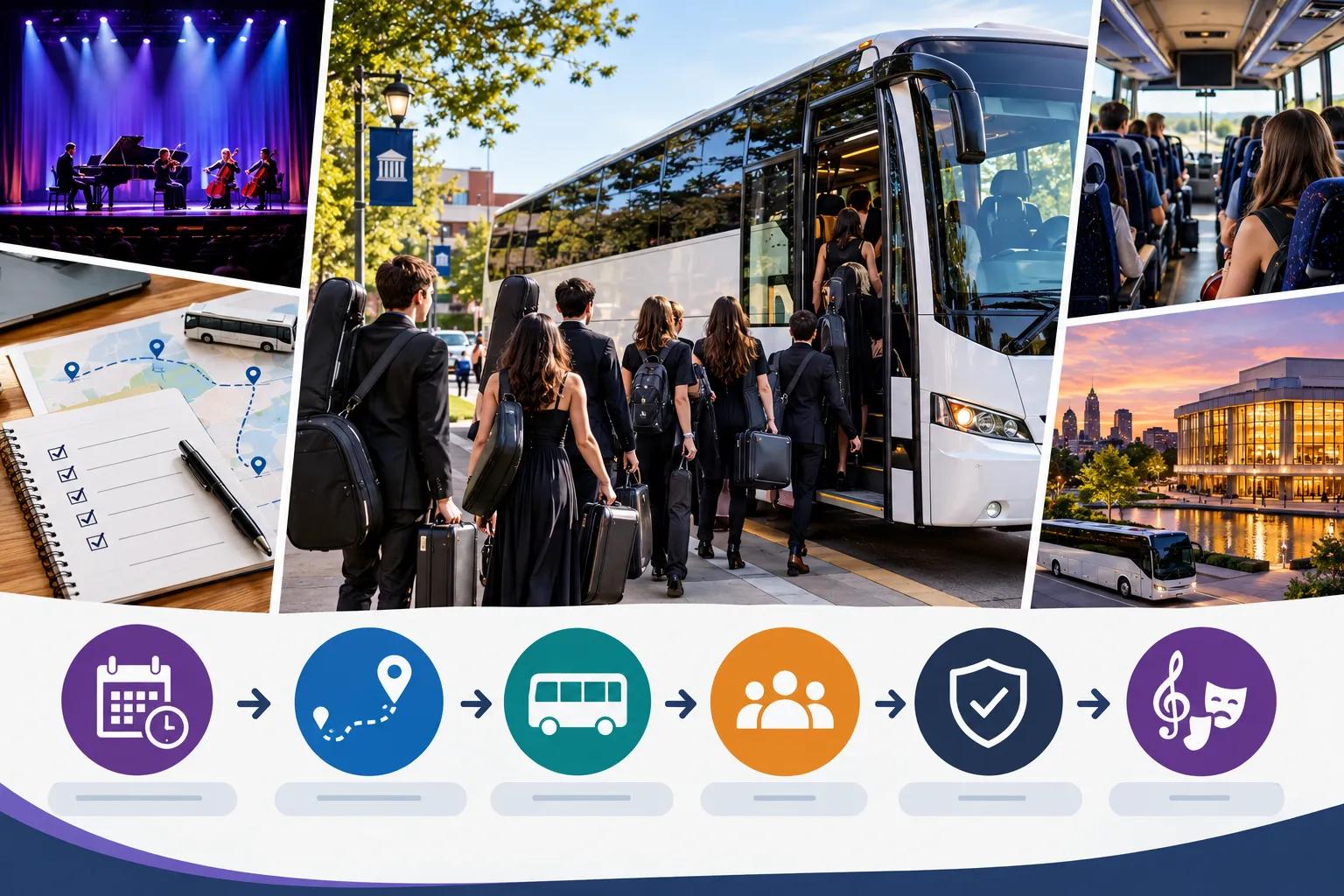
A Guide to Safe and Reliable University Performing Arts Tour
University performing arts tours give students valuable opportunities to perform at festivals, schools, theaters, conferences, and cultural events outside their campus. However, organizing transportation for a choir, orchestra, dance company, or theater troupe requires careful planning. Performers need to arrive rested and prepared, while instruments, costumes, props, and technical equipment must reach every venue safely. Reliable university performing arts tour transportation can help staff coordinate these requirements while keeping the tour schedule organized and manageable.

Start With a Detailed Transportation Plan
Safety and reliability begin with preparation. Before booking transportation, university staff should create a complete itinerary covering every day of the tour. Departure times, travel routes, rehearsal periods, performance schedules, meal breaks, hotel stays, and return trips should all be considered.
A detailed schedule allows the transportation provider to understand exactly how the vehicles will be used. It also helps identify potential conflicts before the tour begins. For example, a late evening performance followed by a long drive may require an overnight stay rather than an immediate return to campus.
Building reasonable time buffers into the schedule is equally important. Traffic, venue access, equipment loading, and parking can all take longer than expected.
Choose Vehicles That Match the Group
The safest transportation plan is one that properly matches the vehicle to the number of passengers and the amount of equipment being carried. A full-size motorcoach may be appropriate for a large choir or university ensemble, while a smaller vehicle may work better for a chamber group or faculty team.
Passenger capacity should never be the only consideration. An orchestra may have dozens of instruments, while a theater company can travel with costumes, props, sets, and technical equipment. A dance company may require portable flooring and costume racks.
When the equipment cannot comfortably or safely fit in passenger storage compartments, a separate cargo vehicle can provide a better solution. Keeping bulky equipment separate can also make loading and unloading more efficient.
Review the Operator's Safety Practices
Universities should consider the transportation provider's overall safety practices before confirming a booking. Ask about driver qualifications, vehicle maintenance, insurance coverage, and procedures for handling unexpected issues.
A professional transportation provider should be able to explain how vehicles are maintained and how drivers are scheduled for long trips. Universities can also ask how the provider handles substitute vehicles or other contingencies if an unexpected mechanical problem occurs.
Safety should remain a priority throughout the entire tour rather than being treated as a single booking requirement.
Consider Driver Scheduling and Rest
A performing arts tour can involve long days. A group might leave campus early in the morning, travel several hours, rehearse in the afternoon, perform in the evening, and load equipment after the show.
Transportation planners should consider the driver's schedule when building the itinerary. Long travel following a late performance may not always be practical for a single driver. An overnight stay or additional driver coverage may be necessary depending on the itinerary.
This is also important for performer safety. Students and staff can be exhausted after a full performance day, so avoiding unnecessarily long late-night journeys can make the entire tour safer and more comfortable.
Protect Instruments and Performance Equipment
University performing arts groups often travel with expensive instruments and equipment. Some instruments may belong to students or faculty members, while others may be owned by the university.
Equipment should be loaded by a designated team that understands how to handle the group's specific gear. Fragile instruments should receive appropriate protection, and cases should be secured to prevent unnecessary movement during transportation.
An equipment inventory can make every departure more organized. Before leaving a venue, the loading team can confirm that all instruments, costumes, props, and technical equipment are accounted for.
Temperature can also affect certain instruments. Sensitive equipment should not be left exposed to extreme heat or cold for extended periods. Staff should discuss appropriate transportation and storage procedures before the tour begins.
Coordinate With Performance Venues
Venue access can have a significant effect on transportation safety and efficiency. A coach may not be able to use the same entrance as passenger cars, and some venues have designated loading docks or restricted parking areas.
Before every tour stop, organizers should confirm where the bus should arrive, where passengers will be dropped off, where equipment can be unloaded, and where the vehicle can park during the performance.
Height restrictions and narrow access roads should also be checked in advance. Providing accurate venue information to the driver can prevent unnecessary maneuvering in crowded areas.
Good communication with venue staff also makes load-in and load-out safer because everyone understands where performers and equipment should move.
Organize Loading and Unloading
Equipment loading should be treated as an important part of the transportation schedule. Rushing to load a bus after a performance can increase the risk of damaged equipment or forgotten items.
A loading captain can supervise a small team of students and staff. The same process should be followed at each venue so everyone understands their responsibilities.
Equipment that needs to be unloaded first should be positioned accordingly. Fragile items should be separated from heavy cases, and costume bags should be protected from equipment that could crush or damage them.
Once everything has been loaded, the responsible person should check the inventory before the vehicle departs.
Keep Performers Comfortable
Performer comfort contributes to a successful tour. Students who arrive exhausted may have difficulty concentrating during rehearsals or performances.
Long journeys should include appropriate opportunities to stretch and take breaks. Comfortable seating and climate control can also make extended travel easier.
Different performers may have specific needs. Vocalists may benefit from quiet periods before concerts, while dancers may need additional warm-up time after traveling. Instrumentalists may need time to unpack and prepare their instruments.
Transportation schedules should provide enough time between arrival and performance for these preparations.
Establish Clear Bus Procedures
Clear boarding procedures can improve both safety and reliability. Students should know the exact bus call time and designated boarding location before every departure.
Section leaders can help conduct attendance, while the tour manager confirms that everyone is aboard before departure. Students should also know what to do if they become separated from the group.
The same system should be followed after performances. Load-out can be busy, so establishing a specific meeting point helps ensure that students are ready when the bus is scheduled to leave.
A consistent bus-call policy also prevents small delays from accumulating throughout a multi-day tour.
Assign Responsibilities to Staff and Students
Transportation works more smoothly when responsibilities are clearly divided. The tour manager can coordinate with the transportation provider and driver, while the production manager oversees equipment.
Section leaders can assist with attendance, and designated student loaders can help with instruments and other equipment. Faculty members or chaperones can focus on student supervision and welfare.
This structure keeps the director or conductor focused on the performance rather than requiring them to solve transportation issues immediately before going on stage.
Prepare for Multi-Day Tours
Multi-day tours require additional attention because transportation is connected to hotels, meals, rehearsals, performances, and rest periods.
A schedule that is too aggressive can leave performers exhausted by the final performance. Building rest periods into the itinerary can help students maintain their energy throughout the trip.
Hotel arrangements should also be coordinated with transportation requirements. If the same driver remains with the group for multiple days, driver lodging and other arrangements should be confirmed ahead of time.
Prepare for Unexpected Situations
Even a carefully planned tour can encounter traffic delays, weather problems, venue changes, or unexpected equipment issues. Having a contingency plan can make these situations easier to manage.
The tour manager should have current contact information for the transportation provider, driver, venues, hotels, and university contacts. Families and campus administrators can also be given a single emergency contact rather than being directed to multiple staff members.
Keeping communication centralized makes it easier to respond quickly when plans change.
Build Safety Into the Budget
A transportation budget should account for more than the basic vehicle rental. Costs may vary according to vehicle size, number of vehicles, travel distance, number of tour days, parking, tolls, driver lodging, and additional driver requirements.
Universities should provide the complete itinerary when requesting a quote. Passenger numbers, equipment requirements, overnight stays, and performance schedules can all affect the transportation solution.
Planning these details in advance helps prevent unexpected transportation expenses later.
Conclusion
Safe and reliable university performing arts tour transportation requires careful coordination between performers, staff, drivers, venues, and equipment teams. The process begins with a detailed itinerary and continues through appropriate vehicle selection, driver scheduling, equipment protection, venue coordination, and clear boarding procedures.
Universities should also prioritize performer comfort and allow enough time for rehearsals, warm-ups, rest, loading, and unexpected delays. When responsibilities are clearly assigned and communication remains centralized, transportation becomes much easier to manage.
With thoughtful preparation and dependable group transportation, university choirs, orchestras, dance companies, and theater groups can travel confidently between performances. A well-planned transportation strategy not only supports safety and reliability but also gives performers and staff the freedom to focus on what matters most: delivering successful and memorable performances.